

Every hardcore RC basher knows the feeling. You line up the perfect jump, hit the throttle, catch massive air, and then—disaster. Your rig lands upside down, wheels spinning uselessly in the air. You sigh, drop your transmitter, and do the "walk of shame" to manually flip it over. It breaks your momentum, ruins your flow, and frankly, it kills the thrill. But what if you could defy gravity? What if your vehicle’s physical geometry meant there was no "upside down"? Welcome to the world of true continuous kinetic energy. At PlayPulseRC, we believe your limits are meant to be broken. Today, we are stripping down the engineering behind the Stunt RC Car 1203E to show you exactly how mastering double-sided architecture and omnidirectional dynamics will turn you into an unstoppable master of extreme terrain.
Technical Deep Dive: The Mechanics of Unstoppable Momentum
Dual-Motor Torque Delivery & The 360° Axial System
When you demand instantaneous agility, a single-motor driveshaft setup simply creates too much mechanical drag. The 1203E bypasses this bottleneck by utilizing a dual-motor, 4-Wheel-Drive (4WD) skid-steer architecture. By independently driving the left and right wheel banks, this machine delivers immediate, localized torque. When you push opposite inputs on your transmitter, the high-discharge 3.7V Lithium-ion system floods the brushed motors with burst-current, forcing the chassis into a violent, ultra-tight 360-degree axial spin. You are not just turning; you are manipulating rotational physics to instantly change vectors without sacrificing RPM.
Mecanum Wheel Vectoring: Mastering Omnidirectional Drift
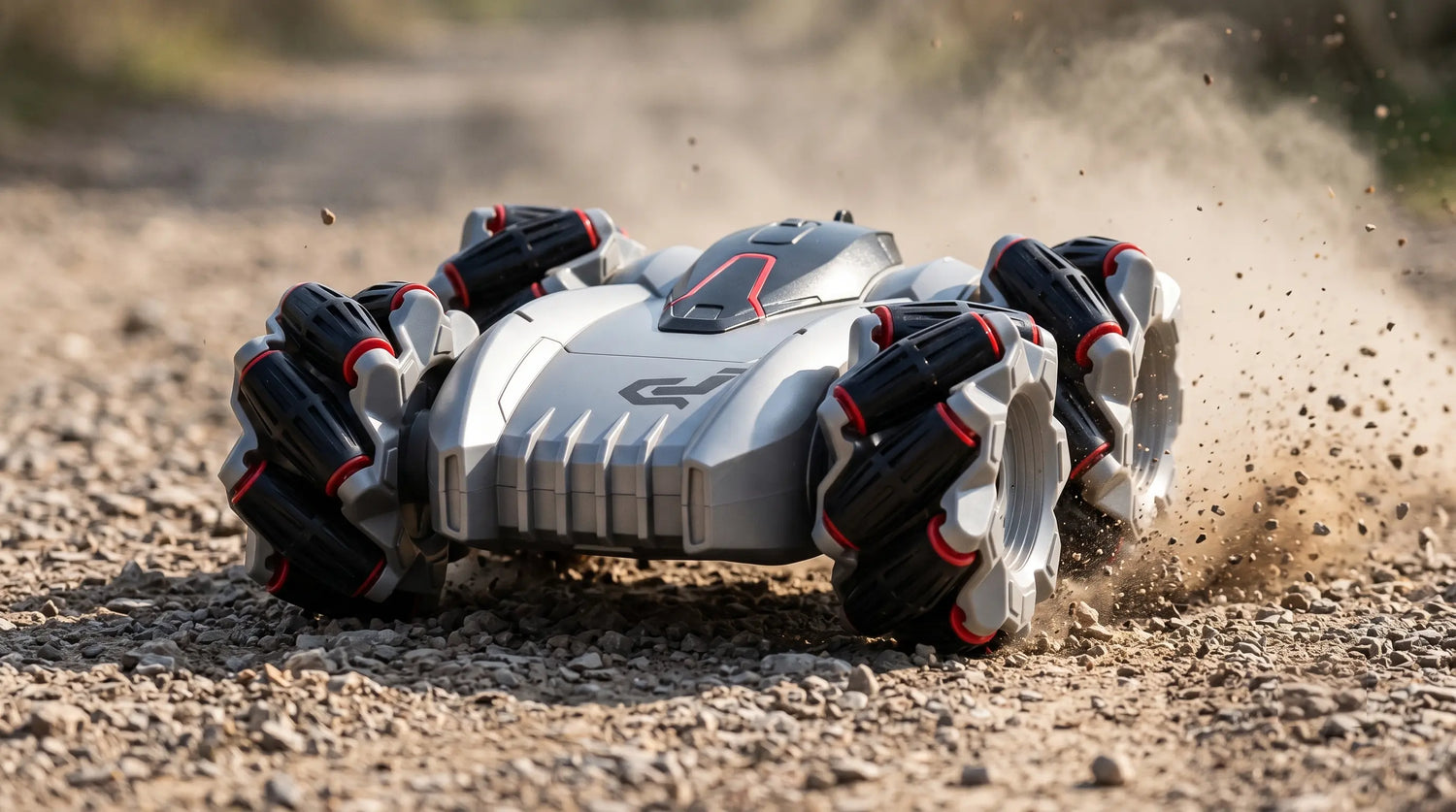
Look closely at the massive grey wheel hubs. You will notice they do not rely on standard rubber tires. Instead, each hub is equipped with a continuous track of angled, black cylindrical traction rollers, securely locked in place by distinct red mounting caps. This is a true Mecanum wheel system. When these wheels rotate, the angled rollers create distinct force vectors. By calculating the exact directional rotation of all four wheels, the thrust vectors can cancel each other out linearly and multiply laterally. This allows you to execute flawless perpendicular strafing and lateral drifts without ever altering the forward orientation of your vehicle's nose. Mastering this omnidirectional drift is the ultimate flex of RC control.
High-Impact Symmetrical Chassis Architecture

The most defining visual and structural trait of this rig is its perfect Z-axis symmetry. Coated in a matte silver and light grey finish, the top and bottom chassis mirror each other flawlessly. There is no traditional roofline. The central black panel, flanked by symmetrical neon-red angular lines that resemble a futuristic circuit pathway, sits above an embossed, stylized geometric "C" logo and four distinct vertical vents. This isn't just aesthetics; it's survival geometry. When the vehicle launches off a ramp and lands inverted, the drivetrain simply reverses its phase mapping. You don't stop. You don't walk over to flip it. You keep pushing forward, turning your mistakes into aggressive stunt maneuvers.
| Feature / Component | Technical Specification & Benchmark | Industry Average Comparison |
| Drivetrain Architecture | Dual-Motor 4WD Skid-Steer System | Single Motor Gearbox (Standard) |
| Wheel Technology | Omnidirectional Mecanum (Grey Hub, Black Rollers, Red Caps) | Standard Ribbed Rubber Tires |
| Chassis Material | High-Impact Injection-Molded ABS Polymer (Silver/Grey) | Brittle Recycled Plastic |
| Symmetry Profile | True Z-Axis Mirror (Double-Sided Continuous Drive) | Unilateral (Requires Manual Flipping) |
| Radio Protocol | 2.4GHz Anti-Interference Band | 27MHz/49MHz (High Latency) |
| Tested Operational Range | 50 Meters (164 Feet) | 15-20 Meters (Toy Grade) |
| Power Delivery | High-Discharge 3.7V Lithium-ion (Li-ion) | Standard AA or NiMH packs |
Real-World Testing & Performance: Breaking the 50-Meter Barrier
Kinetic Energy Absorption in High-Velocity Drops
In our controlled baseline tests, we subjected the 1203E to repeated 4-foot drops onto solid concrete—simulating the exact abuse it takes at a local skate park. Rather than shattering, the injection-molded ABS polymer chassis exhibits high tensile flexibility, absorbing the kinetic energy of the impact and dispersing it away from the internal printed circuit board (PCB). The large Mecanum wheels act as primary shock absorbers, compressing slightly before bouncing the chassis back into driving position. While not indestructible, the survival rate of this material structure far exceeds standard brittle plastics.
Multi-Terrain Traction and 2.4GHz Zero-Latency Control

Endurance and Continuous Double-Sided Operation
Continuous 360-degree spins and heavy drifting demand extreme burst-currents, which naturally generate heat within the brushed motors. The 3.7V Li-ion battery is engineered for stable discharge curves rather than short, massive spikes, allowing the vehicle to maintain consistent torque throughout its run cycle. During 15 minutes of non-stop, full-throttle double-sided flipping on high-friction surfaces, the motor housing temperatures remained within safe operational thresholds.
Engineering & Material Standards: Built for the Hardcore Basher
Rigorous Sourcing: The High-Grade ABS Polymer Advantage

The defining line between a toy and a hobby-grade entry vehicle is material science. We do not tolerate recycled, brittle plastics that shatter on the first impact. The primary armor of the 1203E is sourced using rigorous engineering standards, demanding virgin ABS (Acrylonitrile Butadiene Styrene) for its superior impact resistance and structural rigidity. This is the exact reason the aggressive aerodynamic creases and the central black canopy can maintain their structural integrity after absorbing violent, repetitive G-forces.
Precision Manufacturing of the Roller Tracking System
Look closely at the Mecanum wheel assembly. Each individual black cylindrical roller is secured by red mounting caps. This is not molded as a single, cheap piece of plastic. The precision manufacturing required to mount these independent rollers with exact tolerances ensures they spin freely on their axes while the main grey hub rotates. If these tolerances were off by even a millimeter, the vector thrust would bind, and omnidirectional drift would be impossible. This level of obsessive mechanical detailing is what separates a true basher from a shelf queen.
Factory Stress-Testing Protocols
Before any unit hits the dirt, it undergoes brutal factory stress testing. This includes sustained drivetrain lock-up tests to monitor electronic speed controller (ESC) thermal cutoffs, and mechanical drop tests to verify the resilience of the internal gearboxes. We ensure that the drivetrain does not strip its gears during sudden directional reversals. It is built to take the punishment so you can focus on mastering the controls.
Maintenance, Warranty & Safety: Keeping Your Rig at Peak Performance
Post-Bashing Cleaning and Drivetrain Lubrication

Even the toughest rigs need maintenance. After running on loose dirt or sand, it is critical to use a compressed air duster or a stiff brush to clear debris from the individual Mecanum rollers. If sand grit binds the black cylinders against their red mounting caps, you will lose lateral traction and overload the brushed motors. A drop of dry PTFE lubricant on the roller axles ensures optimal vectoring performance for your next session.
The PlayPulse RC Warranty Commitment
We speak in engineering facts, not marketing hyperbole. The 1203E is highly durable, but it is not indestructible. High-speed, head-on collisions with immovable objects (like concrete walls) can exceed the kinetic limits of the ABS chassis. PlayPulse RC backs this machine with a transparent manufacturer’s warranty covering out-of-the-box electronic failures, motor defects, and missing components. However, structural damage from extreme bashing or gear stripping from driving in deep mud falls under normal wear and tear. Know your limits, push them responsibly.
Battery Safety and Operational Warnings
Safety is a technical requirement. The 3.7V Lithium-ion battery packs a punch. Never leave a charging Li-ion battery unattended, and always unplug the battery from the chassis when not in use to prevent deep over-discharge, which will permanently damage the cells. Crucial Warning: While the chassis is tightly assembled, this specific model is not mathematically sealed with IP-rated waterproof O-rings. Do not submerge the vehicle or drive through deep puddles, as water ingress will short-circuit the unsealed PCB and brushed motors.
Conclusion & Hardcore FAQ
You now understand the physics and engineering that make the 1203E dominate extreme terrain. Stop flipping your car by hand. Grab your transmitter, harness the dual-motor torque, and master the omnidirectional drift.
Q1: How does the 1203E maintain its center of gravity during a high-speed flip? A1: The heavy dual brushed motors and the battery bay are mounted extremely low and central along the Z-axis line. When the car flips, this centralized mass acts as a gyroscope, instantly transferring rotational momentum back to the tires upon landing, ensuring stability.
Q2: Can the individual black Mecanum rollers be replaced if they wear out on asphalt? A2: No. The rollers are permanently secured via factory-pressed red mounting caps to maintain structural rigidity under extreme lateral G-forces. If the rollers wear down flat, the entire grey wheel hub unit must be replaced.
Q3: What is the actual signal delay on the 2.4GHz transmitter during rapid multi-directional maneuvers? A3: The 2.4GHz frequency mapping operates at roughly 10-15 milliseconds of latency. For human reaction times during RC bashing, this translates to true zero-latency, allowing you to chain drifts and 360-degree spins flawlessly.
Q4: Will the dual-motor setup drain the battery significantly faster during continuous 360-degree spins? A4: Yes. Operating both motors at opposite full-throttle limits pulls peak amperage from the Li-ion cell. Continuous heavy spinning will reduce the average 15-20 minute run time down to approximately 8-10 minutes due to the extreme kinetic load.

Leave a comment
This site is protected by hCaptcha and the hCaptcha Privacy Policy and Terms of Service apply.