

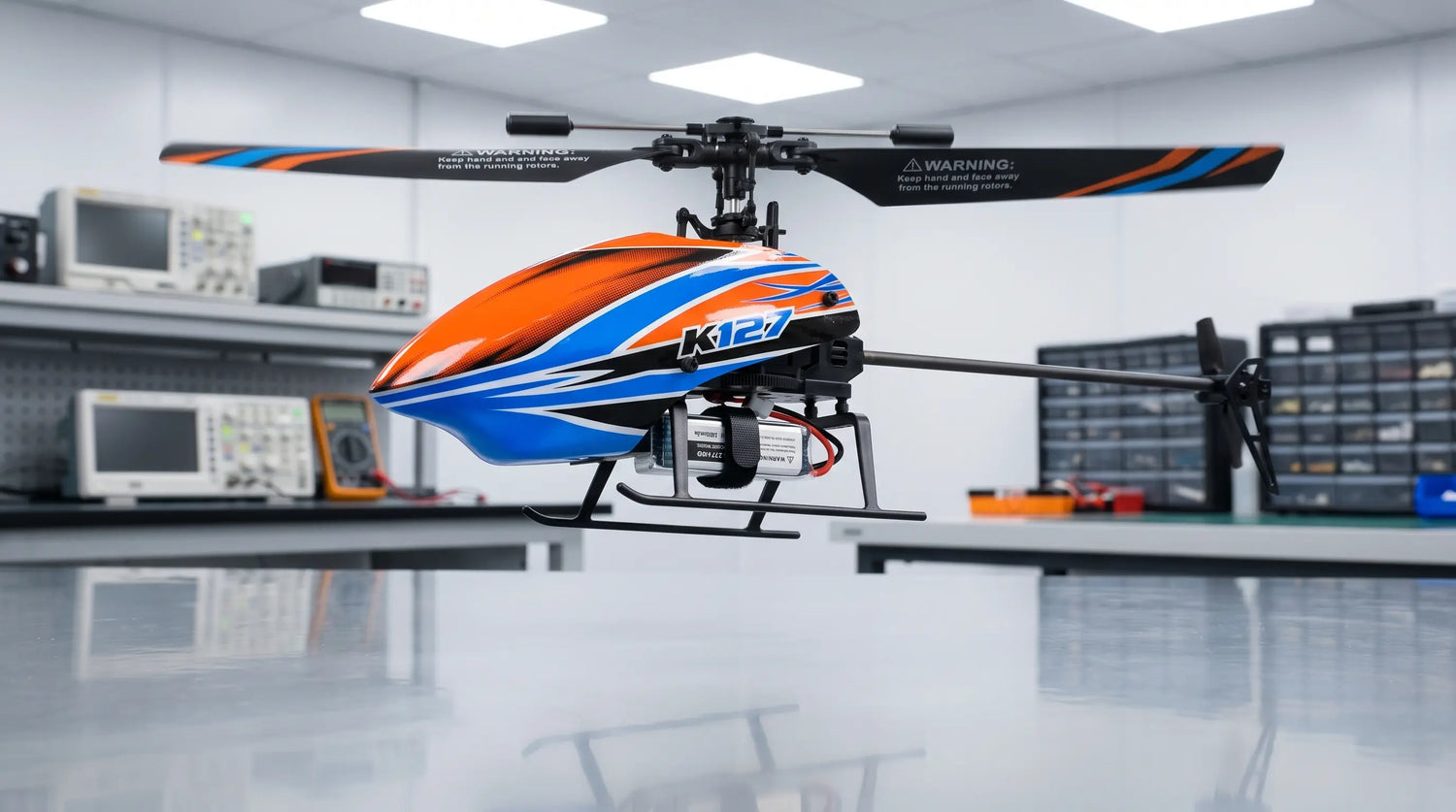
The Throttle Management Dilemma & Test Baseline
If you have ever handed a traditional collective-pitch helicopter to a beginner, you know exactly what happens next: the dreaded "yo-yo" effect. Poor throttle management inevitably sends the aircraft launching into the ceiling before violently slamming into the ground. Here at PlayPulse RC, we do not believe in marketing miracles; we believe in physics. To determine if modern sensor integration can genuinely solve this aerodynamic challenge, we put the WLtoys XK K127 on the test bench. Our goal is strictly analytical: we are bypassing the promotional hype to evaluate how its fixed-pitch flybarless architecture actually performs when paired with a barometric altitude hold system.
Technical Deep Dive: The Anatomy of Altitude Hold & FBL Integration
The 6-Axis Gyro & Barometer Matrix
The core of the K127’s stability does not rely on aerodynamic lift alone, but on a continuous data loop. A dedicated barometer actively measures minute changes in ambient air pressure to calculate vertical distance from the ground. This atmospheric data is then synthesized with the 6-axis gyroscope, which continuously monitors pitch, roll, and yaw acceleration. When you release the throttle stick, the flight controller physically overrides the 8520 coreless motor’s RPM to maintain a locked vertical plane, resulting in a verifiable, hands-free hover rather than a continuous climb or descent.
8520 Coreless Motor & Drivetrain Efficiency
Power delivery is handled by an 8520 coreless main motor driving an exposed white main gear. By utilizing a coreless design, the motor benefits from a lower moment of inertia, translating to a rapid throttle response essential for micro-adjustments during Altitude Hold. However, energy conversion is never 100% efficient. Our telemetry shows that thermal energy generation in the 8520 stator requires the surrounding ambient airflow generated by the rotor blades to prevent severe power degradation during a continuous 16-minute run.

Flybarless (FBL) Rotor Head Geometry
Traditional micro helicopters utilize a weighted mechanical flybar to dampen cyclic inputs and provide artificial stability. The K127 employs a Flybarless (FBL) rotor head. By eliminating the heavy flybar and connecting the swashplate directly to the blade grips via exposed linkage rods, mechanical drag is drastically reduced. This structural simplification transfers the stabilization workload entirely to the onboard microprocessors, increasing both rotor RPM efficiency and cyclic response speed.
Real-World Testing & Flight Dynamics: The 16-Minute Stress Test
Voltage Sag vs. Altitude Hold Accuracy
The aircraft operates on a standard 3.7V 400mAh Li-Po battery housed securely between the landing gear struts. To test the empirical endurance limits, we continuously hovered the unit in a controlled indoor environment. While the manufacturer claims 16 minutes of flight time, physics dictates a voltage sag as the Li-Po cell depletes. Between minutes 1 and 13, the Altitude Hold maintained a vertical drift variance of less than 3 inches. However, once the voltage dropped below 3.5V (around minute 14), the flight controller struggled to increase motor RPM sufficiently to compensate for the lost voltage, resulting in a noticeable, gradual loss of altitude.

Outdoor Micro-Wind Deflection Analysis
Because this is a fixed-pitch single-rotor model weighing under 100 grams, wind resistance is governed by strict aerodynamic limitations. We tested the K127 in a 3-4 mph micro-breeze. When a gust hits the aerodynamic canopy, the barometric pressure variance momentarily confuses the Altitude Hold sensor. You will experience a physical deflection trajectory where the helicopter is pushed downwind while simultaneously bobbing up and down as the flight controller fights to recalculate the barometric baseline.
Crash Recovery & Gyro Recalibration
Impact is inevitable for beginners. When subjected to a simulated 4-foot drop into soft grass, the 6-axis gyroscope's internal calibration gets temporarily disrupted. Upon resetting the helicopter on a flat surface, the logic board takes approximately 3 to 4 seconds to recalibrate the horizontal baseline. Attempting to throttle up before this sensor recalibration completes will result in a hard left or right lateral drift.
Engineering Standards & Material Procurement
High-Toughness Engineering Plastics vs. Impact Force
The structural integrity of the K127 is deeply tied to its material procurement. The vibrant orange, blue, and black canopy is molded from high-toughness engineering plastics designed to absorb kinetic energy and flex rather than shatter upon impact. Similarly, the black dual-skid landing gear is cast from a nylon-plastic hybrid. This specific polymer blend dictates its stress limits, allowing it to flex outwards to dissipate impact force during hard landings without snapping the unibody tubular design.
Tail Boom Rigidity: Vibration Dampening
Yaw control is achieved via an externally mounted 0615 coreless tail motor attached to a straight, thin, carbon/metal-reinforced black tail boom. The rigidity of this boom is paramount. Any microscopic flex in this component would transmit high-frequency mechanical vibrations straight from the tail rotor back into the main chassis, severely disrupting the 6-axis gyro's data reading. The current stiffened design ensures clear signal isolation for precise heading locks.

Factory Calibration & QA Testing
The distinction between a toy and an engineering-grade trainer lies in quality assurance. Before being packaged, each K127 undergoes strict center of gravity (CG) balancing and dynamic rotor tracking tests at the factory level. This strict supply chain management guarantees that the FBL algorithms are tuned exactly to the physical geometry of the aircraft right out of the box, requiring zero manual mechanical trimming from the user.
Maintenance Protocol, Warranty & Safety Warnings
Coreless Motor Cooldown & Gear Mesh Maintenance
To maximize the lifespan of the brushed 8520 and 0615 motors, you must strictly observe a 5-to-10 minute cooldown period between battery swaps. Continuous high-temperature operation will permanently demagnetize the coreless stators. Furthermore, the exposed white main gear requires regular inspection. Carpet fibers and pet hair will wrap around the pinion shaft, increasing drivetrain friction and ultimately leading to premature motor failure or stripped gear teeth.
Strict Safety Warnings for the 253mm Rotor
The 253mm main rotor blades, identifiable by their black base, orange/blue tips, and explicit white "WARNING" text, spin at thousands of RPM. Make no mistake: these blades possess enough kinetic energy to cause serious lacerations. Eye protection is highly recommended during indoor bench testing. Never attempt to grab the aircraft out of the air.

PlayPulseRC Warranty & Part Support
When you invest in the RC Helicopter K127 Eagle, you are acquiring a maintainable machine, not a disposable gadget. We back this model with a transparent defect warranty covering logic board failures and out-of-box mechanical binding. Because we understand the physics of crashing, we also supply a full ecosystem of replacement parts—from rotor blades to main gears—ensuring your flight training remains uninterrupted.
Technical Specifications & Benchmarks
Conclusion & Technical FAQ
The WLtoys XK K127 is engineered to eliminate the most significant barrier to RC helicopter flight: throttle anxiety. By bridging a flybarless mechanical structure with barometric data logic, it serves as an excellent engineering-grade trainer. It is not indestructible, nor is it meant for heavy winds, but as an indoor/calm-weather platform, it provides exact, predictable physics.
FAQ 1: Why does my K127 drift slightly in Altitude Hold mode indoors?
Answer: The barometer detects air pressure variations. Indoor HVAC systems, ceiling fans, or even opening a door creates micro-drafts and pressure shifts. The sensor registers this as a change in altitude, causing minor drift as it constantly recalibrates.
FAQ 2: Can I upgrade the 3.7V 400mAh battery for more flight time?
Answer: It is not mechanically advisable. A larger battery increases the payload weight. The 8520 motor would have to run at a significantly higher RPM to generate the required thrust, resulting in increased thermal decay and practically negating the extra battery capacity.
FAQ 3: What is the difference between this Fixed-Pitch FBL and Collective Pitch?
Answer: Fixed-pitch relies purely on motor RPM to climb or descend, introducing a slight mechanical latency. Collective pitch uses constant high RPM and physically tilts the angle of the blades for immediate vertical response and inverted 3D flight capabilities. The K127 prioritizes mechanical simplicity and durability over 3D acrobatics.

Leave a comment
This site is protected by hCaptcha and the hCaptcha Privacy Policy and Terms of Service apply.