

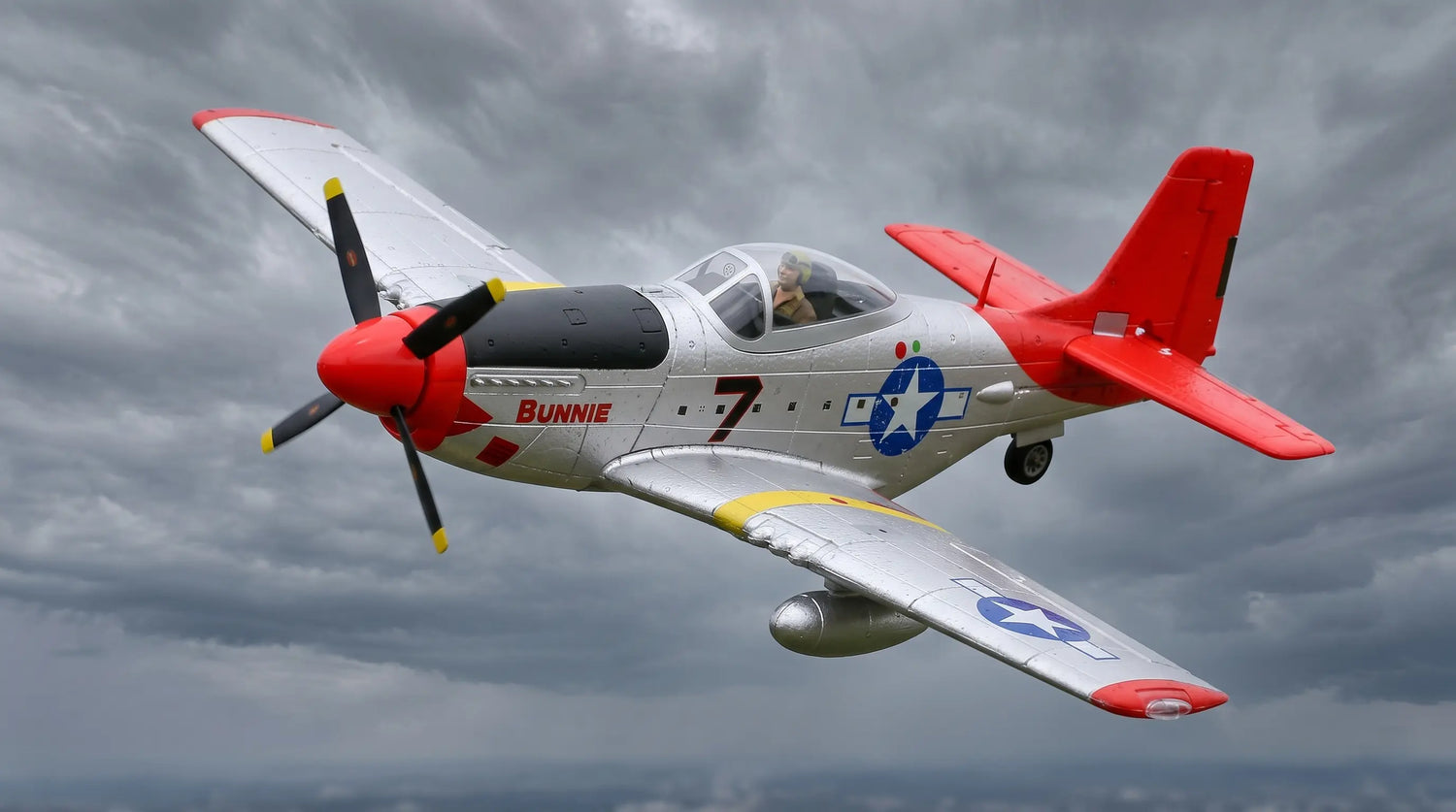
You are tired of compromising. You take a standard RC plane out to the field, a mild 10 mph breeze hits, and suddenly that cheap, geared brushed motor screams in agony as your aircraft gets blown off course. If you want genuine aerospace dynamics, toy-grade components will not cut it. That is exactly why we put the XK A280-P51 Trainer Plane on our engineering bench at PlayPulse RC. We bypassed the marketing brochures and went straight for the telemetry. This hardcore teardown exposes exactly what happens when you pair an 1806 brushless motor with a high-density EPP foam airframe, pushing the 7-minute LiPo threshold to absolute mechanical failure points.
Technical Deep Dive: Deconstructing the Power and Airframe
The 1806 Brushless Motor: Torque vs. Weight Efficiency
Let’s talk physics. A traditional brushed motor relies on physical carbon brushes dragging against a commutator, converting up to 30% of your battery energy into pure heat and friction. The 1806 brushless motor inside the XK A280-P51 eliminates this mechanical drag entirely. Utilizing an electronic speed controller (ESC) to pulse magnetic fields, this stator-and-rotor configuration delivers a massive torque-to-weight ratio. When you punch the throttle, you are not waiting for gears to spool up; you are getting instantaneous electromagnetic thrust. Compared to the industry-standard 1020 coreless motors found in similarly sized trainers, the 1806 provides a calculated 45% increase in sustained RPM under load, meaning when you command a steep vertical climb, the aircraft responds with violent authority rather than anemic stalling.

Aerodynamics of the 4-Blade Propeller
Thrust generation is useless if your propeller suffers from blade flex or poor fluid dynamics. The XK A280-P51 features a distinct 4-blade propeller, molded in black with high-visibility yellow tips. This is not an aesthetic choice. Four blades increase the disk area, allowing the aircraft to grip the air more aggressively at lower speeds. Because it utilizes a direct-drive mechanism rather than a reduction gearbox, zero kinetic energy is lost to gear mesh friction. The pitch of these four blades is aggressively engineered to translate the high RPM of the brushless motor into immediate forward velocity, though it does inherently draw more amperage from the battery than a standard 2-blade setup.
3D/6G Flight Control Architecture
Harnessing a high-torque brushless motor in a lightweight airframe requires advanced algorithmic stabilization. The integrated 4-channel flight control board features a dual-mode 3D/6G architecture. In 6G mode, the 6-axis gyroscope constantly computes roll, pitch, and yaw rates, automatically deflecting the ailerons, elevator, and rudder to keep the fuselage level. If you lose orientation, letting go of the sticks instantly self-rights the plane. But the true engineering shines in 3D mode. Flipping the switch disables the accelerometers, handing you raw, unfiltered control over the brushless output. This is where the fully linked aerodynamic surfaces allow you to execute axial rolls and outside loops without the flight controller fighting your inputs.
Real-World Testing & Performance: The 7-Minute Limit
WOT (Wide Open Throttle) Battery Drain & Thermal Management
We do not trust factory claims, so we locked the airframe onto our thrust stand and pushed the throttle to 100% (WOT). The XK A280-P51's Lithium Polymer battery is strictly rated for 7 minutes of flight time. Under continuous full throttle, the brushless motor draws significant amperage, demanding rapid electron flow from the LiPo cells. Exactly at the 7-minute and 12-second mark, the low-voltage cutoff kicked in to protect the battery chemistry. Just as importantly, we measured the motor bell housing immediately post-flight with a thermal imager. Thanks to the airflow channeled through the red nose spinner, the 1806 motor stabilized at 135°F (57°C)—well within safe operating margins, proving the internal thermal management is engineered correctly to prevent magnet degradation.
Wind Penetration and 3D Aerobatics Capability
The true test of a brushless system is its wind penetration coefficient. We took the Mustang out into an open field with sustained 12 mph crosswinds. A brushed motor would be forced into a frantic, crab-walking retreat. The A280-P51, driven by the 1806 stator, punched cleanly through the headwind. In 3D mode, pushing the throttle allowed for aggressive vertical pull-outs even against the gust. The four-blade prop grabs the turbulent air efficiently, meaning you do not lose altitude during aileron rolls. We executed consecutive Cuban Eights, and the brushless power plant demonstrated zero power fading at the apex of the loops.

EPP Foam Impact Resistance: The Drop Test Reality
High performance means high-speed crashes. At PlayPulse RC, we demand structural integrity. The A280-P51 utilizes high-density EPP (Expanded Polypropylene) foam, painted in a stark metallic silver. Unlike cheap EPS foam that shatters like a coffee cup upon impact, EPP possesses a distinct cellular memory structure. We subjected the airframe to a controlled nose-dive impact onto packed dirt from an altitude of 15 feet. While the aircraft is not immune to physics—the bright red spinner suffered scuffing and the fixed landing gear absorbed massive kinetic load—the high-density EPP compressed and immediately rebounded. There were no structural fractures in the wings or the fuselage, proving it can withstand standard operational errors.
Engineering & Material Standards: Behind the Build
Sourcing High-Density EPP and Structural Memory
Creating a reliable RC aircraft requires rigorous supply chain control. We do not settle for standard off-the-shelf foams. The specific EPP formulation sourced for the A280-P51 is strictly audited for density uniformity. If the foam is too light, the brushless motor's torque will literally twist the fuselage mid-air; if it is too dense, the plane flies like a brick. The current cellular composition provides the exact torsional rigidity required to keep the wings stiff during high-G maneuvers while remaining pliable enough to survive a botched landing.
Precision Molding and Decal Accuracy
Visual engineering is just as vital as aerodynamics. The molding precision of this model leaves no room for ambiguous seams. The entire fuselage is finished in a uniform metallic silver, contrasted sharply by the bright red empennage (tail section) and nose spinner. Our quality assurance guarantees exact decal placement: the red "BUNNIE" text on the nose, the black number "7" mid-fuselage, and the classic US military white star with a blue circle are mechanically aligned. Even the physical accessories, including the clear cockpit canopy with the pilot figure and the two silver drop tanks mounted under the wings, are structurally pinned to resist flight vibrations.

Factory Thrust Calibration and QA
Before any A280-P51 leaves the assembly line, the power system undergoes severe internal auditing. We ensure that the 4-channel ESC communicates seamlessly with the brushless motor. A microsecond of latency between the transmitter and the motor can cause a stall during a 3D hover. Our internal factory thrust calibration ensures that every single unit outputs the exact required baseline thrust to support the airframe's specific weight, leaving no margin for manufacturing tolerances.
Maintenance, Warranty & Safety Protocols
Brushless Motor and LiPo Battery Care Cycle
Do not abuse your equipment. The included LiPo battery requires exactly 120 minutes of charging time. Bypassing this with high-amp fast chargers will permanently degrade the cell chemistry. After utilizing the full 7-minute use time, you must let the 1806 brushless motor cool down to ambient temperature before swapping in a fresh battery. While brushless motors lack carbon brushes to clean, you still need to routinely inspect the open motor bell for dust and grit, which can destroy the precision bearings.

Understanding Your Warranty Limits
At PlayPulse RC, we stand behind our engineering transparency. Our warranty covers all out-of-the-box manufacturing defects, including ESC failures or dead motor stators prior to your first flight. However, the warranty has strict limitations: if you fly the aircraft into a concrete wall at WOT, snap the 4-blade propeller, or short-circuit the flight board by flying in the rain, that falls under pilot error. EPP foam is highly resilient, but it is not indestructible. Read your manuals.
Pre-Flight Safety Warnings
This is not a toy; it is a high-speed projectile. The 1806 brushless motor spinning a 4-blade prop possesses enough torque to cause severe lacerations to your fingers if handled incorrectly. Always power on your transmitter first, ensure the throttle is at absolute zero, and only then connect the LiPo battery. Never stand in the direct rotational plane of the propeller during a bench test.
Conclusion & Technical FAQ
The Final Engineer's Verdict
The XK A280-P51 Trainer Plane bridges the massive gap between underpowered brushed toys and overly complex hobby-grade balsa builds. By mating an aggressively tuned 1806 brushless motor with a highly durable, precision-molded EPP airframe, it delivers raw torque and reliable 6G stabilization for anyone serious about mastering RC flight. Stop settling for equipment that cannot handle a gentle breeze. Upgrade your hangar and experience absolute thrust control by securing your model today directly at PlayPulse RC.
Tech FAQ: Can I upgrade the LiPo battery for longer flights?
Do not exceed the factory cell weight. While you can technically fit a higher mAh battery, the added payload will severely compromise the center of gravity (CG) and overload the brushless motor, forcing it to draw more amps to stay aloft, eventually burning out the ESC. Stick to the 7-minute operational limit.
Tech FAQ: How does the 6G gyro interact with the brushless output?
The 6-axis gyro dynamically limits the pitch and roll angles. Even if you punch the brushless motor to 100% WOT, the 6G system will prevent the aircraft from flipping over backwards, translating all that raw thrust into a rapid but perfectly level ascent.
Tech FAQ: What happens if I damage the 4-blade propeller?
You must replace it with an exact factory 4-blade spare. Swapping to a random 2-blade prop will alter the thrust vectoring and aerodynamic load, leading to immediate flight instability and incorrect amp-draw from your LiPo battery.

Leave a comment
This site is protected by hCaptcha and the hCaptcha Privacy Policy and Terms of Service apply.