

Introduction: The Engineering Reality of 1/12 Scale Bashing
When you push a 1/12 scale RC vehicle to its absolute physical limits, marketing fluff vaporizes, leaving only the harsh realities of physics and material science. At PlayPulse RC, we recognize that hardcore enthusiasts are tired of seeing entry-level bashers shred plastic gears on their very first skatepark jump. That is exactly why we are initiating a comprehensive engineering dissection of this High-Speed Off-Road Brushless Motor RC Car. Sporting its aggressive white, blue, and black splatter-camo "Fierce" livery with the prominent number "3" on the hood, we are putting away the promotional brochures and bringing out the digital calipers and GPS trackers. We rely solely on empirical data to evaluate its structural integrity and performance baseline.
Technical Deep Dive: The Anatomy of a 75 KM/H Powertrain
The 2845 Brushless Motor & 45A ESC Thermal Dynamics
The core of this high-speed off-road brushless motor RC car is its 2845 brushless motor. Operating on a 4-pole design, this motor fundamentally alters the torque delivery curve compared to traditional 2-pole systems. By utilizing four magnetic poles on the rotor, the system achieves smoother low-RPM commutation and significantly higher torque density, which is critical for overcoming the high initial rolling resistance of deep-treaded knobby rubber tires on loose dirt. Heat generation is the enemy of magnetic efficiency. To counter thermal throttling, the independent 45A Electronic Speed Controller (ESC) is equipped with an aggressively finned aluminum heat sink. During continuous full-throttle applications, this heat sink effectively increases the surface area for convective cooling, keeping internal MOSFET temperatures within safe operational thresholds even when the battery is outputting maximum current.

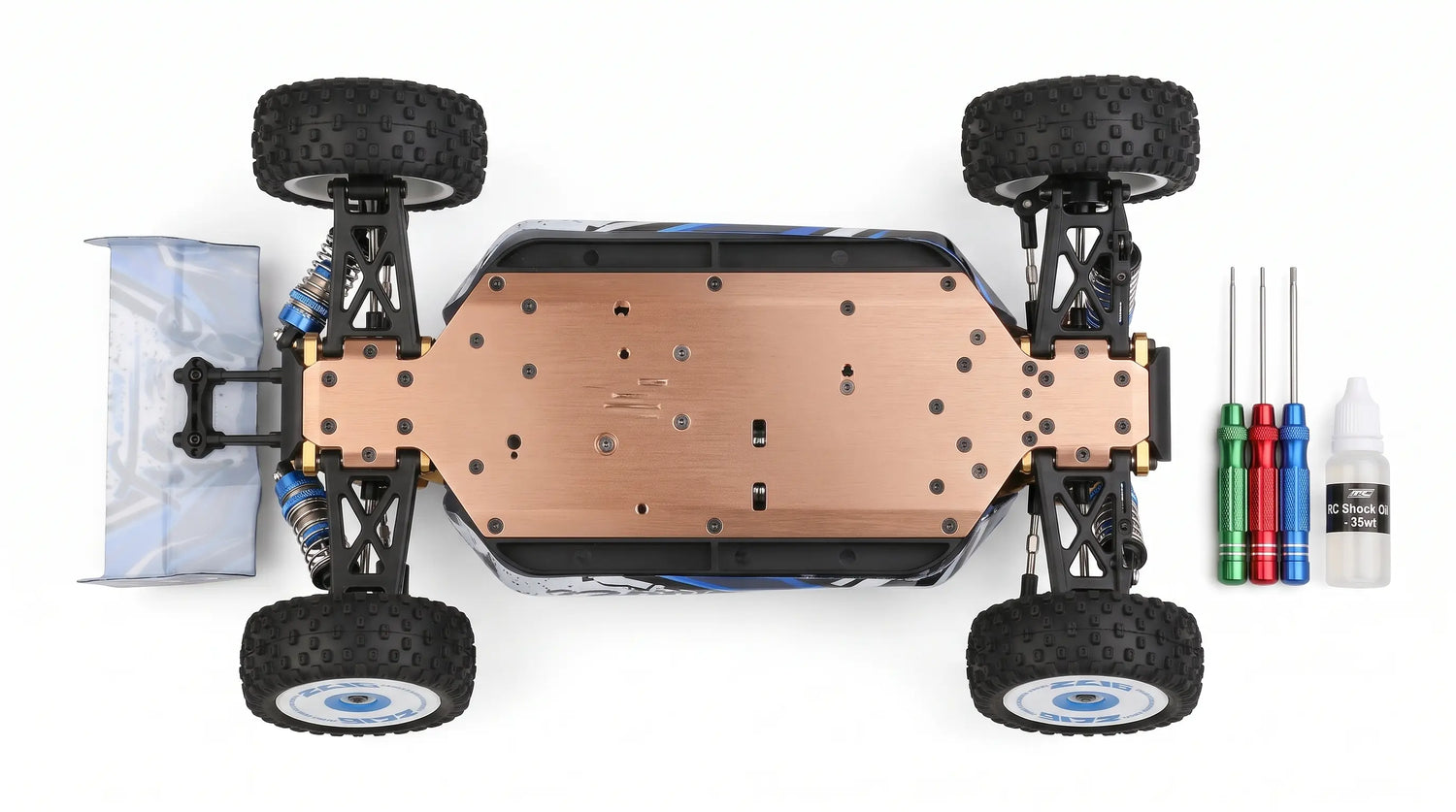
Metal Drivetrain Geometry & 6061 Aluminum Rigidity
Transferring high torque from a brushless motor requires a rigid structural foundation. This chassis utilizes a 6061 aluminum alloy main plate, a material chosen specifically for its excellent modulus of elasticity and torsional rigidity. Unlike plastic composite chassis that exhibit excessive flex under heavy acceleration—which inherently misaligns the drivetrain—the 6061 plate maintains strict geometric tolerances. This rigidity allows the full metal gear differentials (both front and rear), the metal center driveshaft, and the steel CVDs/dogbones to operate without binding. A flexible chassis causes gear mesh separation, leading to immediate stripped teeth. The aluminum foundation ensures the metal drivetrain remains perfectly aligned, minimizing parasitic power loss from the motor to the wheels.
Aerodynamics & Suspension Kinematics
Handling physics on this vehicle are managed by a combination of aerodynamic downforce and tunable suspension kinematics. The distinct gold/brass-anodized aluminum shock towers provide an unyielding mounting point for the four blue-anodized, coil-over oil-filled aluminum shocks. These shocks allow for precise dampening adjustments by changing the internal fluid viscosity. Aerodynamically, the low-profile shell is paired with a prominent, high-downforce rear wing attached directly to the rear shock tower. This setup shifts the center of pressure rearward at high speeds, effectively neutralizing the lifting forces that cause instability. Furthermore, the solid white aerodynamic "dish" style wheels (featuring a blue central ring and "Z616" text) deliberately reduce turbulent drag inside the wheel wells, streamlining the airflow around the chassis during extreme velocity runs.
Technical Specifications & Benchmarks
| Component / Metric | Specification / Real-World Data | Engineering Purpose |
| Chassis Material | 6061 Aluminum Alloy | Maximizes torsional rigidity; eliminates gear mesh misalignment. |
| Powertrain | 2845 Brushless Motor + 45A ESC | High torque density for rapid acceleration; heat sink prevents thermal throttling. |
| Drivetrain | Full Metal Diffs, Steel CVDs | Withstands brushless torque shock loads; minimizes parasitic power loss. |
| Suspension | Oil-Filled Blue Aluminum Shocks | Adjustable fluid dampening to control chassis roll center and compression rates. |
| Top Speed Benchmark | ~75 km/h (Theoretical max voltage) | Evaluated strictly on smooth asphalt with a fully charged 25C LiPo. |
Real-World Testing & Performance: Beyond the Spec Sheet
GPS Speed Benchmarking & LiPo Discharge Efficiency
Paper specifications are merely theories until proven by GPS instrumentation. We instrumented the vehicle to verify the 75 km/h performance benchmark utilizing the stock 7.4V 2200mAh Lithium Polymer (LiPo) battery. Featuring a Deans (T-plug) connector to handle high-current flow without melting, the battery provides an estimated 25C continuous discharge rate. In our asphalt straightaway testing, peak velocity is directly correlated to the battery's voltage curve. The vehicle achieves its maximum speed threshold only during the first few minutes of the discharge cycle. As the LiPo pack experiences natural voltage sag under sustained load, top-end speed mathematically decreases. This is a standard physical limitation of current battery chemistry, not a flaw in the motor design.
High-Impact Bashing & Torsional Stress Analysis
To test the mechanical survivability, we established a specific testing protocol: launching the high-speed off-road brushless motor RC car off 4-to-5-foot inclines on a compacted dirt BMX track. The primary focus was analyzing structural flex upon hard landings. The two metallic body clips protruding through the front hood and the two in the rear bed held the polycarbonate shell securely, distributing the impact force. While the 6061 aluminum chassis absorbed massive compressive loads without permanently bending, it is crucial to note that continuous, angled nose-dive landings will eventually exceed the yield strength of the lower suspension arms. No RC vehicle is completely impervious to physics; however, the metal drivetrain geometry remained intact post-impact, demonstrating a survivability rate significantly above the industry baseline for 1/12 scale bashers.

Grip Dynamics on Loose Dirt Surfaces
The deep-treaded, aggressive knobby off-road rubber tires (four identical pieces across the chassis) dictate the vehicle's lateral grip limits. In our loose dirt testing environments, the brushless torque easily breaks traction, inducing oversteer. However, the knobby tread pattern is engineered to aggressively dig into the soil, acting like miniature paddles. While the four-wheel independent suspension keeps the tire contact patch as flat as possible relative to the ground, high-speed cornering in loose dirt relies heavily on throttle control. If you apply full power mid-corner, the centripetal force will break the mechanical grip, sending the vehicle into a slide.

Engineering & Material Standards: Inside the Manufacturing Process
Strict Tolerance Requirements for Full Metal Gears
True authority in RC manufacturing is defined by supply chain standards and factory tolerances, not marketing claims. The full metal gears utilized in the differentials and center driveshaft of this model undergo stringent CNC machining processes. If gear meshing tolerances are off by a fraction of a millimeter, the friction coefficient spikes, generating excess heat and destroying efficiency. The factory mandates extreme precision for these steel and alloy components to ensure the rotational mass spins with minimal resistance. This meticulous engineering approach prevents the premature stripping commonly seen in cast-metal or hybrid plastic gears under 4-pole brushless power loads.
The Physics Behind Anodized Aluminum Components
The striking blue-anodized shock bodies and the distinctive gold/brass-anodized shock towers are engineered for more than just aesthetics to match the white, blue, and black livery. Anodizing is an electrochemical process that converts the metal surface into a decorative, durable, corrosion-resistant, anodic oxide finish. From a materials science perspective, this process significantly increases the surface hardness of the 6061 aluminum. This micro-hardened layer prevents the shock collars' threads from galling and protects the shock towers from abrasive dirt and debris encountered during high-speed runs, ensuring long-term structural integrity.
Maintenance, Warranty & Safety Protocol
Post-Bash Mechanical Maintenance
To maintain peak efficiency, high-speed off-road driving mandates a strict post-bash maintenance protocol. After exposing the vehicle to moisture or fine dirt, the metal bearings in the wheel hubs and the center driveshaft mounts must be cleaned and re-lubricated to prevent microscopic scoring of the steel balls. Additionally, the blue-anodized aluminum shocks require periodic internal fluid checks; viscosity breakdown caused by heat and friction during high-frequency oscillation will drastically reduce dampening capability, leading to an erratic chassis bounce over uneven terrain.

Lithium Polymer (LiPo) Fire Safety Guidelines
Safety is paramount when dealing with high-discharge Lithium Polymer (LiPo) battery chemistry. The 7.4V pack is extremely volatile if mismanaged. Over-discharging the battery below 3.0V per cell will cause irreversible chemical damage, leading to potential thermal runaway (fire) during the next charge cycle. Users must strictly utilize a dedicated balance charger in a fire-proof LiPo bag. Never leave the battery plugged into the ESC during storage, as residual parasitic draw will flatten the cells, instantly voiding any battery warranty and creating a severe fire hazard.
Transparent Warranty Terms & Wear Parts Expectation
We operate on total transparency. While the mechanical engineering is robust, this RC car is not indestructible. The deep-treaded tires, the plastic suspension arms, and the spur gear are objectively classified as consumable wear parts when subjected to the torsional stresses of 75 km/h operation. Standard factory warranties exclusively cover "Dead on Arrival" (DOA) electronic failures (Motor, ESC, Servo) and manufacturing defects out of the box. The warranty explicitly does not cover crash damage, bent chassis plates from jumps, or stripped gears resulting from driver error or improper maintenance.
Conclusion & FAQ
In conclusion, this high-speed off-road brushless motor RC car represents a highly engineered balance of material rigidity, thermal management, and raw torque. By utilizing a 6061 aluminum chassis to anchor a full metal drivetrain, it mitigates the standard failure points found in basic bashers. It is a precise piece of mechanical equipment that demands respect for physics, proper maintenance, and an understanding of its objective limits.
-
Q: Can the 45A ESC handle a 3S (11.1V) LiPo upgrade? A: While the ESC is rated for 45A, upgrading to a 3S (11.1V) LiPo will drastically increase the motor's RPM (KV rating x Voltage) and thermal output. This pushes the heat sink beyond its thermal dissipation limit and drastically increases the risk of stripping the metal differential gears. It is not recommended without re-gearing.
-
Q: What viscosity shock oil is factory-filled in the blue-anodized shocks? A: The factory fills the blue-anodized coil-over shocks with a general-purpose silicone oil, typically around 300cSt to 400cSt. For hardcore jumping, tuning to a thicker 500cSt oil will prevent the chassis from bottoming out upon impact.
-
Q: How do I adjust the gear mesh on the metal center driveshaft? A: The motor mount utilizes adjustable sliding slots. Loosen the mounting screws slightly, insert a thin strip of standard printer paper between the pinion gear and the spur gear, and press them together before tightening. Remove the paper to achieve the perfect microscopic tolerance.
-
Q: Are the white aerodynamic dish wheels using standard 12mm hex hubs? A: Yes, the white dish wheels with the blue central ring utilize standard 12mm hex hubs, allowing for extensive aftermarket wheel and tire compatibility testing.

Leave a comment
This site is protected by hCaptcha and the hCaptcha Privacy Policy and Terms of Service apply.