

Engineering Breakdown: High-Speed RC Tank Off-Road Crawler
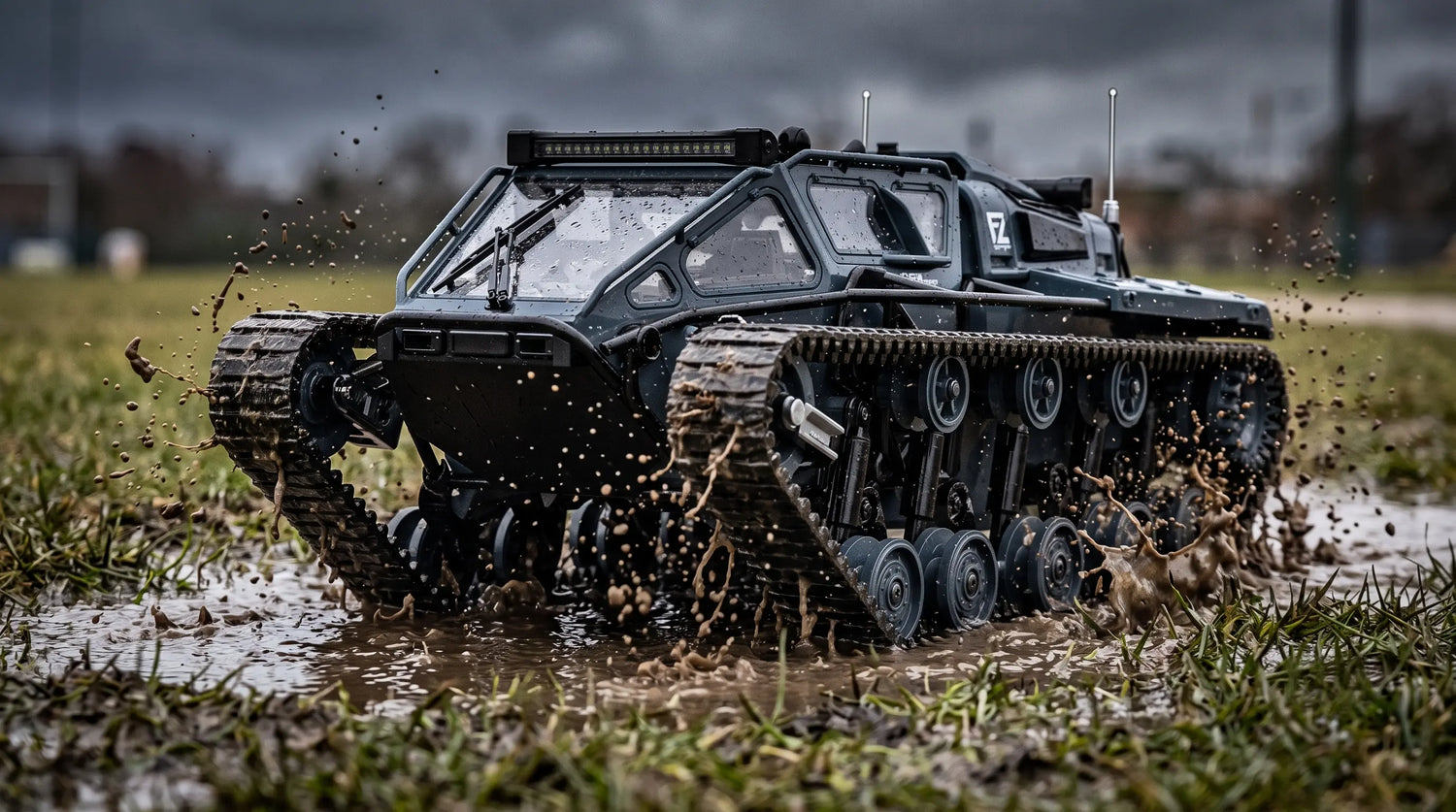
When tackling loose dirt, deep sand, or unpredictable snowy trails, traditional wheeled RC bashers face an unavoidable physics problem: traction loss and wheel spin. The structural limitations of independent wheeled suspension often result in getting stuck when the terrain demands consistent ground contact. To solve this, enthusiasts turn to tracked platforms. In this engineering breakdown, we evaluate the mechanical architecture of the 1/12 High-Speed RC Tank Off-Road Crawler, available at PlayPulseRC. This is an objective analysis of how its dual-stream transmission and independent suspension geometry perform under verifiable off-road stress tests.
Technical Deep Dive: Deconstructing the Tracked Powertrain
Dual-Stream Gearbox & 380-Class Motor Efficiency
A tracked vehicle requires exponentially more low-end torque than a wheeled counterpart due to the continuous friction of the tracks. This 1/12 scale platform utilizes a dual-stream drive gearbox driven by a 380-class brushed motor. Unlike standard differentials that bleed power to the path of least resistance, the dual-stream system mechanically locks the power delivery, allowing for neutral steering (pivoting on its own axis) and consistent torque distribution. While brushed motors naturally exhibit more heat and lower peak RPM than brushless equivalents, the specific gear reduction ratio employed here successfully translates the 380 motor’s output into a highly capable crawling torque, sacrificing top-end bashing speed for sustained traction on 30-degree inclines.

Independent Torsion Suspension Geometry
The true capability of an off-road crawler lies in its track-to-ground contact patch. This chassis features a highly calculated 7-wheel layout per side: one raised front idler wheel, five ground-contact road wheels, and one raised rear drive sprocket. More importantly, each of the five lower road wheels utilizes an independent torsion bar or spring suspension system. When navigating uneven rock formations, this independent articulation allows the lower wheels to contour to the obstacles, maintaining a continuous track footprint. Compared to fixed-bogie tanks which bounce over rocks, this multi-point articulation significantly reduces high-centering and power loss over jagged terrain.
Exoskeleton Roll Cage & Impact-Resistant Chassis
The physical construction integrates stealth-aircraft style faceted, angular body panels with a solid black tubular roll cage (exoskeleton). This is not merely aesthetic. In the event of a rollover during high-speed descents, the tubular guardrail system distributes the kinetic impact energy across the ABS polymer chassis, protecting the integrated ESC/Receiver board located beneath the transparent windshield. The matte dark grey main body panels are reinforced at critical stress points, and the black front lower skid plate operates as a deflection shield to prevent track-jamming debris from wedging into the front idler wheels.
Real-World Testing & Performance Benchmarks
High-Speed Cornering & Track Retention Dynamics
Track throwing (derailment) is the most critical failure point for high-speed tracked RC vehicles. To empirically test track retention, we subjected the platform to consecutive high-speed drifts on loose gravel and hard-packed dirt. The raised front idler wheel maintained sufficient mechanical tension during sharp lateral slides. Over a 10-minute session of aggressive cornering, the tracks remained seated inside the road wheel grooves. However, driving laterally across severe inclines (side-hilling) does introduce track flex; users must ensure the track tension is manually verified before aggressively side-hilling to prevent derailing under extreme lateral loads.

Extreme Incline & Articulation Capabilities
In our physical trail tests, we evaluated the vehicle's climbing efficiency on a 35-degree compacted soil incline mixed with roots. The aggressive tread pattern of the track bit effectively into the terrain. The front approach angle (calculated from the front skid plate to the idler wheel) is aggressive enough to mount standard curb-height obstacles without nose-diving.
The primary limitation observed was sheer gravity overcoming the overall vehicle weight (approximately 1.2kg) at angles exceeding 40 degrees, which is a standard physical limit for 1/12 scale crawlers before backward tipping occurs.
Battery Discharge Curve & Thermal Management
Power delivery relies on a 7.4V 1200mAh Li-ion battery with an estimated 10C-15C discharge rate. During a continuous 15-minute high-load test involving mixed throttle on thick grass and gravel, the battery output remained linear for the first 11 minutes before exhibiting a noticeable voltage drop, triggering the ESC's low-voltage cutoff. Thermal telemetry of the 380 motor housing registered at 68°C (154°F) post-run. This temperature indicates efficient heat dissipation through the chassis venting, remaining well within the safe operational threshold for brushed motors, though mandatory cool-down periods between battery swaps are highly recommended.

Engineering & Material Standards: The Manufacturing Reality
Sourcing High-Wear Vulcanized Rubber Tracks
The durability of any crawler is directly correlated to its material procurement. Rather than relying on brittle, linked hard-plastic segments typical in low-tier models, the brand's internal manufacturing standard demands a continuous-loop track made from high-wear-resistant vulcanized rubber or a heavy-duty nylon composite. This procurement choice drastically reduces the brittleness that causes track snapping in sub-zero temperatures. Internal R&D material testing ensures the track compound provides sufficient durometer softness for rock grip while retaining enough tensile strength to withstand the rotational torque of the drive sprockets.
Strict QA and Pre-Shipment Stress Testing
Authority in RC engineering stems from transparent factory standards. Before packaging, the assembly line implements a rigorous Quality Assurance (QA) protocol focusing on drivetrain tolerances. The dual-stream gearbox undergoes a dry-run mesh test to identify high-friction points or improper gear seating. Additionally, the IPX4 splash-proof enclosure surrounding the central electronics is subjected to localized moisture testing. This internal baseline ensures that the final consumer receives a mechanically sound unit straight out of the box, reflecting a deep understanding of supply chain quality control.
Maintenance, Warranty & Operational Safety
Drivetrain Maintenance & Tension Adjustment
To maximize the lifespan of the off-road crawler, proactive maintenance is required. The high-friction nature of a dual-stream gearbox means lubrication is non-negotiable. After operating in sandy or dusty environments, use a stiff brush and compressed air to clean debris from the rear drive sprocket teeth. Neglecting this will cause premature wearing of the track guiding holes. Apply a dry PTFE/Teflon-based lubricant to exposed metal axles; avoid wet oil greases that attract abrasive dirt.
Realistic Warranty Coverage & Limitations
Transparency is paramount. The factory warranty typically covers electronic failures (such as ESC malfunction or dead motors) resulting from manufacturing defects under normal operating conditions. It is critical to state that this vehicle is not indestructible. Structural damage resulting from extreme bashing—such as launching the 1.2kg tank off skatepark ramps causing ABS chassis fractures or snapped torsion bars—is classified as user abuse and is strictly excluded from warranty coverage.
Li-ion Battery Safety & IPX4 Limitations
Safety warnings must be strictly observed. The included 7.4V 1200mAh Li-ion battery poses a fire hazard if punctured or over-discharged. Always store the battery at a 50% storage charge in a fireproof bag when not in use. Furthermore, while the chassis carries an IPX4 splash-proof rating, this is strictly a limitation against light puddles and wet grass. Submerging the vehicle above the lower road wheels—specifically allowing water to breach the roof vents or the twin vertical rear antennas where the receiver sits—will instantly short-circuit the ESC.

Technical Specifications & Benchmarks
| Specification Category | Verified Hardware / Metric | Engineering Benchmark Notes |
| Powertrain & Motor | Dual-Stream Gearbox, 380-Class Brushed | Optimized for torque rather than top-end bashing speed. |
| Battery Chemistry | 7.4V 1200mAh Li-ion (10C-15C) | Yields ~15 mins runtime under high-load continuous driving. |
| Suspension Layout | 7-Wheel Track Geometry, Independent Torsion | 5 road wheels feature independent multi-point articulation. |
| Track Material | Vulcanized Rubber / Nylon Composite | High durometer resistance against sharp rock tearing. |
| Water Resistance | IPX4 Splash-Proof | Protects against wet grass/puddles. NOT fully submersible. |
| Safety Features | Integrated ESC Low-Voltage Cutoff | Prevents Li-ion cell degradation from over-discharging. |
Conclusion & FAQ
For enthusiasts looking to cross the bridge between high-speed bashers and methodical rock crawlers, the 1/12 High-Speed RC Tank presents a robust engineering solution. By utilizing a dual-stream gearbox and independent torsion suspension, it resolves the fundamental traction loss associated with traditional wheeled models on loose terrain. While its brushed power system and IPX4 rating require realistic operational discipline, its mechanical architecture stands as a highly capable platform for extreme off-road terrain.
FAQ
Q1: How do I adjust track tension if it starts slipping during steep climbs? A1: Track slipping usually occurs if the front idler wheel mechanism is compromised or if debris is jammed in the rear drive sprocket. Clean the sprockets thoroughly with a brush. If tension is permanently lost, inspect the track for stretch fatigue and consider replacing the continuous rubber loop.
Q2: Are the internal dual-stream gearbox gears prone to stripping under heavy load? A2: The gear mesh is designed to handle the torque of the 380 motor. However, instantly applying full reverse throttle while traveling at max forward speed will cause massive kinetic shock to the gears, which can lead to stripping. Always brake to a stop before reversing.
Q3: Can this RC tank be fully submerged in mud or water? A3: Absolutely not. The vehicle is rated IPX4, which strictly means it can withstand water splashes from any direction. Deep mud or submerging the chassis up to the windshield will instantly destroy the unsealed ESC and receiver board.

Leave a comment
This site is protected by hCaptcha and the hCaptcha Privacy Policy and Terms of Service apply.