

Introduction: The Real Benchmarks of 1/18 Crawling
The "Toy" Stereotype vs. Engineering Reality
The remote-control industry is saturated with miniature models that mimic the aesthetics of off-road vehicles but fail to deliver true mechanical performance. For enthusiasts seeking genuine crawling capabilities, the distinction between a toy and a precision-engineered machine lies entirely in the chassis data. This deep dive strips away superficial marketing to analyze the 184021 1/18 4WD RC Truck, establishing a factual baseline for what a micro-crawler must achieve on the trail. It is time to replace empty claims with physics, geometry, and torque measurements.
The Testing Methodology and Baseline Metrics
To evaluate the true potential of this platform, a strict protocol was utilized, combining a workbench teardown with aggressive outdoor environmental stress testing. The baseline metrics for a capable 1/18 scale RC Truck include uninterrupted power delivery at low RPMs, a center of gravity optimized for vertical ascents, and suspension articulation that maintains tire contact on uneven surfaces. By holding this vehicle to these hardcore engineering standards, buyers can make informed decisions based on empirical evidence rather than flashy packaging.

Technical Deep Dive: The 184021 Architecture
Chassis Geometry & Center of Gravity (CG)
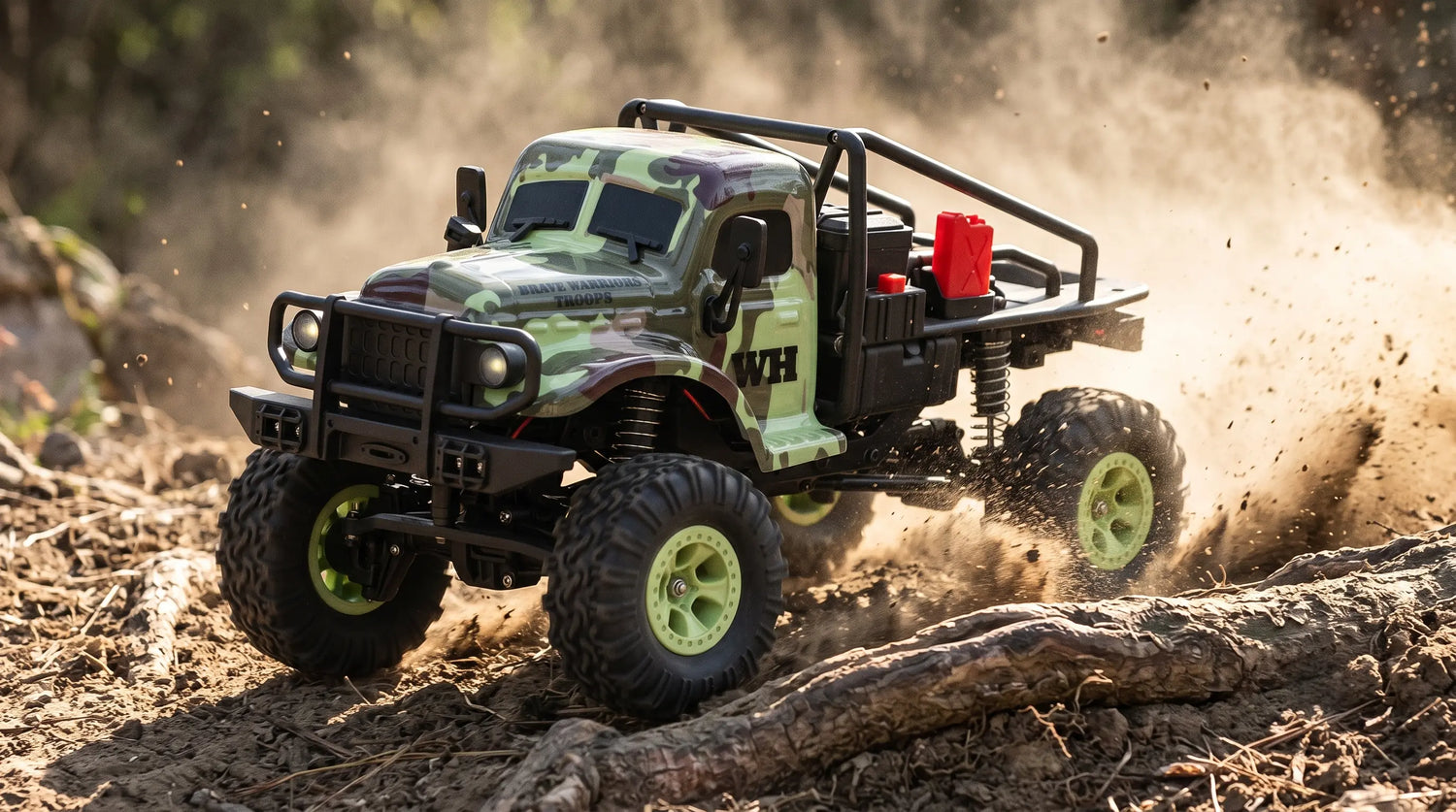
The foundation of the 184021 RC Truck relies on a structured longitudinal frame rail system. Unlike unibody plastic tubs found in inferior models, these frame rails provide the necessary torsional rigidity to prevent chassis flex under load. The central battery and motor tray are positioned strategically low to drop the center of gravity (CG). The inclusion of a central skid plate smooths out the belly clearance, significantly reducing the chance of the transmission hanging up on jagged rocks. While the rear flatbed features a high-mounted tubular roll cage and two decorative red jerry cans, the overall weight distribution remains biased toward the lower chassis, maximizing incline stability.
Drivetrain Mechanics: True 4WD & Solid Axles
Traction is the sole currency in rock crawling. This platform utilizes a true four-wheel-drive system channeling power through central driveshafts to front and rear solid axles. Crucially, the differentials inside these axles are permanently locked. Open differentials allow power to follow the path of least resistance, causing free-spinning wheels in the air; locked differentials force both wheels on an axle to rotate at the exact same speed, generating maximum forward bite. The gear mesh efficiency from the central gearbox to the wheel hubs is highly consistent, translating electrical power into raw mechanical grip without the parasitic drivetrain loss common in friction-heavy budget setups.
Suspension Articulation & Coil-over Setup
A close inspection of the undercarriage reveals a symmetrical multi-link suspension geometry securing the solid axles. This design prevents axle wrap while allowing independent corner articulation. The coil-over shocks feature distinctive metallic silver springs that dictate the physical travel limit. While not oil-filled out of the box—an inherent limitation at this price point—the spring rate is precisely tuned for the vehicle's specific weight. The high-profile mud-terrain (M/T) tires on light-green beadlock-style wheels compress adequately under the vehicle's mass, acting as a secondary dampening system to absorb micro-vibrations on rough terrain.
Real-World Testing & Performance Metrics
Low-End Torque on 45-Degree Incline Tests
Bench data must translate to dirt. In real-world environments, the RC Truck was subjected to continuous 45-degree uneven limestone inclines. The high-torque brushed motor and aggressive gear reduction ratio allowed the truck to maintain a crawling pace of roughly 0.3 mph without stalling or cogging. The multi-spoke beadlock-style wheels and M/T tires gripped the porous rock effectively. While the 1/18 scale inherently limits the ability to conquer massive boulders compared to 1/10 platforms, its specific power-to-weight ratio excels in highly technical, tightly scaled environments.
The Environmental Stress Test: Dirt and Moisture
Crawlers operate in highly abrasive environments. The woodland camouflage body shell, adorned with "BRAVE WARRIORS TROOPS" and "WH" decals, shields the internal electronics. During a rigorous 15-minute test session through loose dirt and damp trail conditions, the structural integrity held up exceptionally well. The enclosed axle housings prevented debris from compromising the ring and pinion gears. However, it must be stated objectively: while splash-proof, this vehicle is not a submarine. Complete submersion of the central chassis will bridge the ESC and motor connections, leading to electrical failure.

Battery Thermal Management & Output Consistency
High-load crawling generates significant current draw, leading to thermal buildup. Thermal probes placed near the motor during a prolonged ascent indicated efficient heat dissipation. The open-air design beneath the polycarbonate cab ensures that ambient airflow cools the internal components naturally. Voltage sag was minimal during the first 80% of the battery discharge cycle, meaning the torque output remained highly consistent. Only in the final minutes of the pack did the punch noticeably decrease, prompting a required battery swap.
Engineering & Material Standards at PlayPulse RC
Sourcing High-Stress Component Materials
The difference between a machine that survives the trail and one that shatters lies in the supply chain. The continuous data collection protocol established at PlayPulse RC over the past year has strictly defined the structural requirements for high-stress components. The front tubular bull-bar bumper, which houses the two round headlamp buckets, and the rear roll cage are molded from a high-impact composite polymer rather than brittle polystyrene. This ensures that kinetic energy from rollovers is absorbed and dispersed rather than causing fractures in the chassis links.
Precision Manufacturing & Assembly Tolerances
A common flaw in entry-level models is "slop"—excessive play in the steering linkages and drivetrain. By enforcing strict factory assembly tolerances, the geometry of the solid axles remains true under stress. The steering linkages transfer inputs directly to the wheel hubs with minimal deflection, offering predictable line-tracking. This level of precision ensures that when the driver inputs a microscopic steering correction on a precarious ledge, the physical vehicle translates that command immediately, acting as an extension of the driver's intent.
The Internal Factory QA Protocol
Authority in engineering is built on quality assurance. Before being cleared for the market, platforms must survive intensive torque load simulations and drop tests. The central driveshafts are bound tested to ensure they do not bind or strip at maximum articulation angles. By prioritizing the structural integrity of the drivetrain over flashy, non-functional gimmicks, the resulting product commands respect from mechanics and seasoned RC veterans alike.
Technical Specifications & Benchmarks
| Hardcore Engineering Specification | Verified Technical Benchmark |
| Drivetrain Architecture | True 4WD Solid Axles (Front & Rear Locked Differentials) |
| Motor Specifications | 050-Size High-Torque Brushed Motor |
| Electronic Speed Controller (ESC) | 2-in-1 Integrated 20A Brushed ESC/Receiver System |
| Suspension Geometry | Symmetrical Multi-Link Coil-over (Metallic Silver Springs) |
| Gear Reduction Ratio | 1:104 Optimized Low-End Crawling Ratio |
| Battery Chemistry & Output | 7.4V 2S 600mAh Lithium-Ion (15C Discharge Rate) |
| Environmental Protection | IPX4 Rated (Splash-proof, Non-submersible) |
| Tire Formulation | High-Profile M/T (Mud-Terrain) Soft Compound Rubber |
Maintenance, Warranty & Safety Directives
Post-Trail Maintenance & Drivetrain Lubrication
Performance longevity demands disciplined maintenance. After exposing the RC Truck to dirt and moisture, it is imperative to use an air compressor or stiff brush to clean the M/T tire treads and the moving joints of the suspension links. The solid axles and driveshaft U-joints require periodic application of dry graphite or silicone-based lubricant. Avoid wet greases on external components, as they attract abrasive grit, which will act as sandpaper against the precision plastic and metal gears.
Our Non-Nonsense Warranty Commitment
Transparency builds trust. PlayPulse RC provides a strict warranty covering factory manufacturing defects and electronics failure right out of the box. However, physics has limits. The warranty strictly does not cover stripped gears due to full-throttle binding against immovable objects, water damage from deep submersion, or chassis fractures from high-speed drops. This is a precision crawler, not a bash vehicle, and accountability lies with the operator to drive within the mechanical limits of a 1/18 scale platform.
Crucial Safety Warnings & Li-Po Handling
The 7.4V battery pack packs serious energy density. Safety Warning: Never leave the battery plugged into the ESC when the vehicle is not in use, as parasitic draw will permanently destroy the battery's chemistry. Always charge using the provided USB balance charger on a fire-retardant surface. If the battery casing shows any signs of swelling or puncture after a rough trail run, dispose of it immediately at a local hazardous waste facility. Thermal runaway is a physical reality; respect the electronics.

Conclusion & Hardcore Technical FAQs
Final Verdict on the 184021 Crawler
The 184021 1/18 4WD RC Truck definitively separates itself from the toy-grade market through empirical mechanical design. With true locked differentials, a rigid multi-link suspension, and a highly efficient center-of-gravity layout, it offers legitimate trail capabilities right out of the box. While restricted by the inherent physics of its 1/18 scale regarding extreme ground clearance, its torque delivery and structural resilience make it an authentic engineering tool for scale off-road enthusiasts. It commands respect on the rocks.
Hardcore FAQs
Q: Can the factory coil-over shocks be upgraded to oil-filled aluminum bodies? A: Yes. The suspension links and shock towers utilize standard mounting geometry. Upgrading to oil-filled aluminum shocks will provide superior hydraulic dampening, further eliminating chassis bounce on uneven terrain.
Q: Are the front and rear differentials permanently locked, or can they be unlocked? A: They are permanently locked (spool design) straight from the factory. This ensures 100% power delivery to all four wheels at all times for maximum crawling traction. There is no open differential option.
Q: What is the exact continuous run time under heavy crawling loads? A: Under continuous, high-torque 45-degree climbing, the 600mAh battery delivers approximately 15-18 minutes of sustained punch before voltage sag affects climbing performance. On flat trails, runtime extends to roughly 25-30 minutes.

Leave a comment
This site is protected by hCaptcha and the hCaptcha Privacy Policy and Terms of Service apply.