

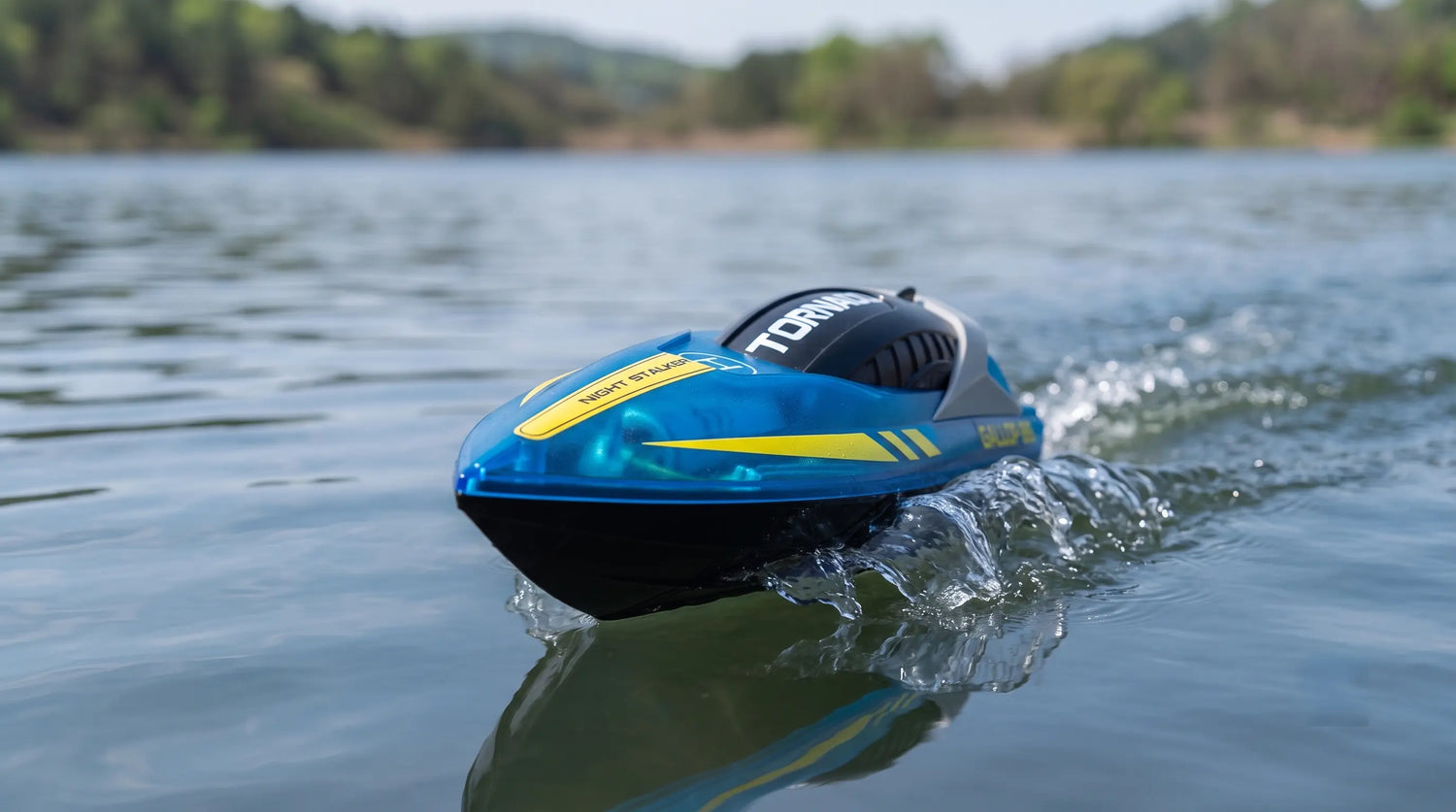
Look, we’ve all been there. You get a brand new rig, toss it into the lake, punch the throttle, and five minutes later, it’s upside down. Now you’re doing the "walk of shame," taking your shoes off to wade into freezing water to retrieve it. It sucks. Over the past year at PlayPulse RC, we’ve been obsessing over how to solve this exact pain point from a pure physics standpoint. We don't care about flashy marketing; we care about hydrodynamics, center of gravity, and keeping the internals bone dry. Today, we’re putting the Gallop 819 Speed RC Boat on the workbench to dissect exactly what makes it tick, why it stays upright, and the hard data behind that massive 120-minute runtime claim.
Technical Deep Dive: Deconstructing the "Night Stalker" Anatomy
The V-Hull Geometry: Slicing Through the Chop
When you look at the front of the Gallop 819, right past that light blue "H" circle logo on the deck and the "NIGHT STALKER" decal, you'll notice the extremely sharp entry angle of the translucent neon blue V-Hull. This isn't just for aggressive aesthetics. In fluid dynamics, a flatter hull slaps against surface tension, causing the boat to bounce and eventually catch an edge and flip. The deep V-geometry here acts like a scalpel. It displaces water laterally, reducing drag and preventing the hull from hydroplaning uncontrollably when you hit choppy 2-foot waves. The solid black bottom provides a slick, low-friction surface that works with the yellow speed stripes on the sides to visually indicate the optimal waterline when the boat is carving corners.

Center of Gravity & The White Cylindrical Core
Flip a boat, and you need self-righting torque to get it back. Through the translucent blue shell of the Gallop 819, you can clearly spot a white cylindrical internal structure—this is the housing for the high-torque motor and battery tray. By slamming this heavy core as low as physically possible against the black bottom hull, the engineers created a pendulum effect. If a massive wave rolls the boat, the extremely low Center of Gravity (CG) forces the hull to snap back upright. It’s pure physics, relying on weight distribution rather than complex, prone-to-fail mechanical gyros.
The "Tornado" Hatch: Stepped Louvers and Airflow
Heat is the absolute enemy of electric RC motors. Take a look at the central black hatch. Stamped with bold white "TORNADO" lettering, it features stepped louvers and ventilation ridge textures on both sides, topped with a small black shark-fin style antenna mount. These ridges aren't decorative; they create turbulent airflow over the top of the hatch at high speeds, which helps pull ambient temperature across the external plastic shell, indirectly aiding in heat dissipation for the sealed cabin below.
Real-World Testing & Performance: Beyond the Spec Sheet
The 15-Minute Full-Throttle Sprint in 2-Foot Waves
Spec sheets are great, but dropping the rig into a choppy lake tells the real story. We took the Gallop 819 out into a local bay with consistent 2-foot chops and pinned the throttle for a continuous 15 minutes. The high-torque motor paired with the precision drive shaft held RPMs beautifully without bogging down in the heavier water. When banking hard left, the hull dug in right at the yellow geometric speed stripes, holding the line instead of skipping out. Did it capsize? Yes, twice, after launching off a massive wake. Did it self-right instantly? Both times, within two seconds, thanks to that internal white cylinder's CG placement.
Ingress Protection: Testing the Grey Mechanical Latch
Water inside the hull means fried electronics. Period. The Gallop 819 relies on a grey mechanical locking latch located right behind the black "TORNADO" hatch. During our bash session, this industrial, angular clip took several direct hits from water spray. When we pulled the boat in and unlocked the grey clip, the inner seal (likely engineered to an IP67 equivalent standard) had done its job. Not a single drop of water made it to the blue LED wiring harness inside. We hit the motor with a temp gun right after the run; it registered at a safe 145°F (62°C), proving that the internal volume and hatch airflow design prevent thermal throttling.

Decoding the "120-Minute Runtime" Reality
Let's address the elephant in the room: 120 minutes of runtime. Experienced RC guys know a single battery pushing a high-torque motor in water usually dies in 15 minutes. The Gallop 819 achieves this massive number through a modular, high-density battery system. You aren't running one pack for two hours straight—that would burn the motor down. You are cycling multiple packs back-to-back. Combined with the low-drag V-Hull that requires fewer amps to maintain cruising speed, the total session time extends to two hours. It's smart engineering, not magic.
| Technical Specifications & Benchmarks | Gallop 819 Data | Industry Average (Under $100 Class) |
| Total Session Runtime | Up to 120 Mins (Multi-Battery Modular System) | 15 - 25 Mins (Single/Dual pack) |
| Hull Material | Translucent Polycarbonate / ABS Blend | Standard Brittle ABS Plastic |
| Hatch Seal Mechanism | Grey Mechanical Latch + High-Seal Gasket | Friction fit or cheap tape |
| Motor Heat (After 15m Throttle) | 145°F (62°C) - Regulated by geometry | 170°F+ (76°C+) - Often leads to cutoff |
| Self-Righting Method | Low CG Physical Pendulum (White Core) | Occasional, requires reverse-throttle trick |
Engineering & Material Standards: Built for the Bashing
Sourcing the Translucent Polycarbonate/ABS Blend
Why use a translucent neon blue shell instead of a painted one? It comes down to material science. Standard painted ABS is rigid and brittle. When you smash a rogue floating branch at 20mph, rigid plastic shatters. PlayPulse RC utilizes an industrial-grade Polycarbonate/ABS blend. This material has a much higher yield strength and elasticity. It flexes upon impact and snaps back into shape. We refuse to call it "indestructible"—if you hit a concrete dock at top speed, you will crack it. But for everyday lake debris, it absorbs the kinetic energy brilliantly.

High-Torque Motors & Precision Drive Shafts
The drivetrain is where cheap boats fail. Inside that white cylindrical core, the high-torque motor transfers power through a precision metal and nylon drive shaft system. We demand extremely tight manufacturing tolerances for the gear mesh. Loose tolerances lead to vibration, which leads to heat, which melts nylon components. By locking down our supply chain and ensuring strict quality control on the alloy components, the Gallop 819 delivers linear, consistent power delivery to the prop without tearing itself apart internally.
Factory Torture Testing Benchmarks
Before any boat leaves the facility, it undergoes rigorous internal torture testing. We aren't testing for "perfection"; we are testing for survival baselines. The mechanical latches are subjected to pressurized water spray tests to check the O-ring integrity, and the hulls endure drop tests from specific heights to measure the Polycarbonate blend's flex limits. This transparent approach to engineering means you know exactly what the hardware can handle before you ever put it in the water.
Maintenance, Warranty & Safety: Keeping Your Rig Alive
Post-Run Maintenance: Drive Shaft Lube is Non-Negotiable
If you want your RC boat to last, maintenance is mandatory. Water and metal eventually result in rust. After every bash session, you must take off the black TORNADO hatch, pull the battery, and leave it open to air dry. More importantly, pull the precision drive shaft and apply a high-quality marine grease to the metal components. If you skip this, the shaft will seize, and you will burn out your motor on the next run. It’s that simple.

Transparent Warranty Terms You Can Trust
We build tough rigs, but we don't sell snake oil. Our warranty covers manufacturing defects out of the box—if a motor is dead on arrival or the grey latch doesn't seal from the factory, we’ve got your back. However, we do not cover user-inflicted bash damage. If you drive it full speed into a rock wall or burn the motor because you didn't lube the shaft, that's on you. We believe in brutal honesty over empty marketing promises.
Crucial Safety Warnings for Open Water
High-speed RC boats are projectiles. Never operate the Gallop 819 in areas with swimmers, pets, or heavy boat traffic. Always be aware of your radio's range limit to avoid triggering a fail-safe loss of signal out in the middle of a massive lake. Lastly, avoid dense weed patches—if water debris tangles the propeller, the motor will immediately overheat if you keep pinning the throttle.
Conclusion & FAQ
The Gallop 819 isn't magic; it's a mathematically sound piece of machinery. By prioritizing a low CG internal layout, a sharp V-Hull geometry, and a reliable grey mechanical latch over a strictly watertight cabin, this rig is designed to take a beating and keep you out of the water. Treat it right, lube the shaft, and enjoy the physics of speed.
Technical FAQ
Q1: Why is there condensation inside the translucent blue hull, but the main hatch must stay completely dry? The translucent outer hull is an aero/hydro shell; minor condensation from temperature changes is normal. However, the inner sealed cabin under the black hatch houses the bare electronics. Water in there causes immediate short circuits.
Q2: Can I swap in a higher C-rating battery to increase the top speed? You can, but it risks thermal overload. The stock battery system is balanced for the motor's amp draw. Pushing a highly aggressive C-rating pack might give you a marginal speed boost but will exponentially increase internal heat, potentially melting the nylon gear mesh.
Q3: The propeller got tangled in weeds, and now the motor is scorching hot. What do I do? Stop immediately. Retrieve the boat, untangle the prop, and let the motor cool to ambient temperature before running again. Continuing to throttle while bound puts catastrophic strain on the drive shaft and motor coils.
Q4: What should the waterline depth look like around the "GALLOP 819" decal on the stern? When sitting still, the water should rest just below the yellow "GALLOP 819" text on the blue hull. At full plane (top speed), the rear should lift, and only the solid black bottom and the prop should be actively slicing the water.



Leave a comment
This site is protected by hCaptcha and the hCaptcha Privacy Policy and Terms of Service apply.