

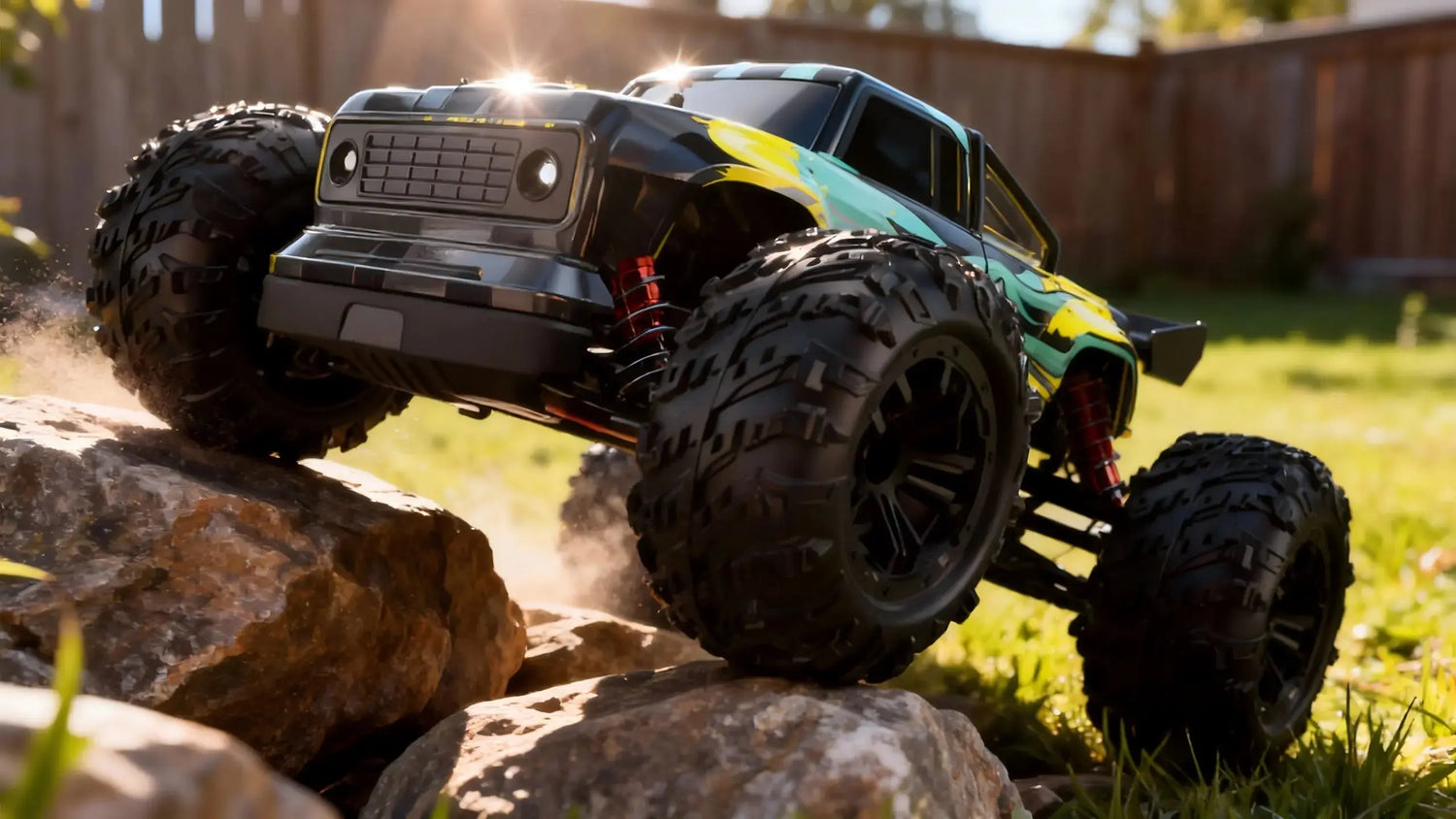
The Ultimate Guide to Alloy Crawler Remote Control Trucks for Teens: Mastering Low-Speed Torque and Family Trail Weekends
If your weekend looks like a short hike, a shallow creek crossing, and a few steep backyard slopes, an alloy crawler remote control truck can turn it into a mini adventure you’ll want to film and share. This guide shows you how to get confident low-speed control, choose the right platform, tune it safely, and plan a parent–child trail session that’s fun for everyone.
Key takeaways
-
Low-speed torque comes from your overall crawl ratio, ESC drag brake, and tire grip—get those right and climbs feel slow, sticky, and controlled.
-
Start with stock gearing, set drag brake high, test on a 20–30° ramp, and watch temps to avoid cooking motors and ESCs.
-
For small scales like 1/24–1/18, worm or portal reductions plus conservative gearing make slow crawls easier without overheating.
-
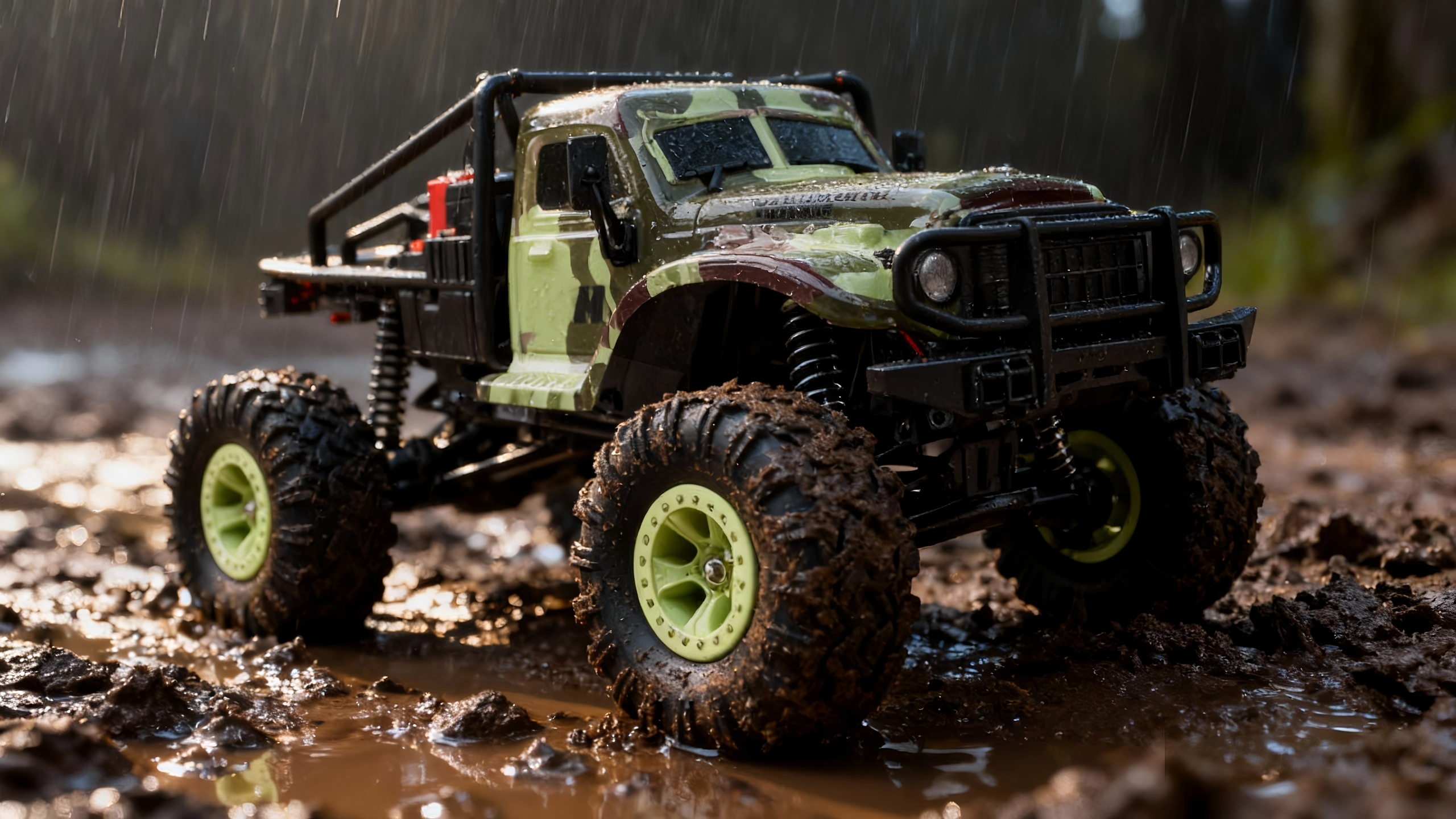
“Waterproof” often means splash-ready, not submarine-proof—treat water with respect, then clean and dry your truck after.
-
Make it a family trail: bring a simple kit, plan a safe route, and capture short, low-angle clips that showcase smooth crawling.
Alloy crawler remote control truck basics
Before you dive into tuning, it helps to align on what makes an alloy crawler distinct. The alloy chassis and links add rigidity and durability for repeated impacts, which supports precise suspension geometry and predictable low-speed balance. For teens filming and sharing, the metal components also photograph well—crisp edges, visible fasteners, and realistic stance—while still staying compact in 1/24–1/18 scales.
How low-speed torque works
Think of your drivetrain like a series of pulleys multiplying force. The higher your overall reduction, the slower the wheels turn for a given motor speed and the more torque reaches the ground. Off-roaders call this the crawl ratio. Formally, crawl ratio is the product of the transmission, axle, and any hub reductions (plus the spur-to-pinion stage where applicable). A larger number favors precise, low-speed control and steeper climbs, as summarized in the general definition of crawl ratio in Wikipedia’s overview of crawl ratios.
A quick illustration: suppose your transmission is 10:1, your axle is 5:1, and your spur-to-pinion stage is 81/12 (≈6.75:1). Your overall is roughly 10 × 5 × 6.75 ≈ 337.5:1. If you add portal hubs around 1.4:1, you end up near 472:1, which makes ultra-slow, ultra-controlled crawling much easier. Portal axles increase hub reduction and ground clearance; see the general explanation of portals in the portal axle article.
Two scale notes for teens picking a first crawler:
-
1/24–1/18: These compact crawlers often use worm gears or high internal reductions that naturally resist rolling backward on steep holds, helping with control.
-
1/10: Bigger, more realistic, and more capable overall—but heavier and costlier to transport and tune.
Mini gear examples
Below is a compact table with simplified gear pairs to show how changing pinion and spur shifts your final reduction. Higher numbers favor torque and slow control.
|
Scale |
Pinion/Spur example |
Stage ratio (Spur/Pinion) |
Example overall with 10:1 trans and 5:1 axle |
|---|---|---|---|
|
1/18 |
12T / 60T |
5.00:1 |
10 × 5 × 5.00 = 250:1 |
|
1/18 |
12T / 72T |
6.00:1 |
10 × 5 × 6.00 = 300:1 |
|
1/10 |
13T / 87T |
6.69:1 |
10 × 5 × 6.69 ≈ 334:1 |
|
1/10 |
11T / 87T |
7.91:1 |
10 × 5 × 7.91 ≈ 396:1 |
These are illustrative only; always verify the actual internal ratios for your model and match gearing to motor limits.
Tuning for control with ESC drag brake
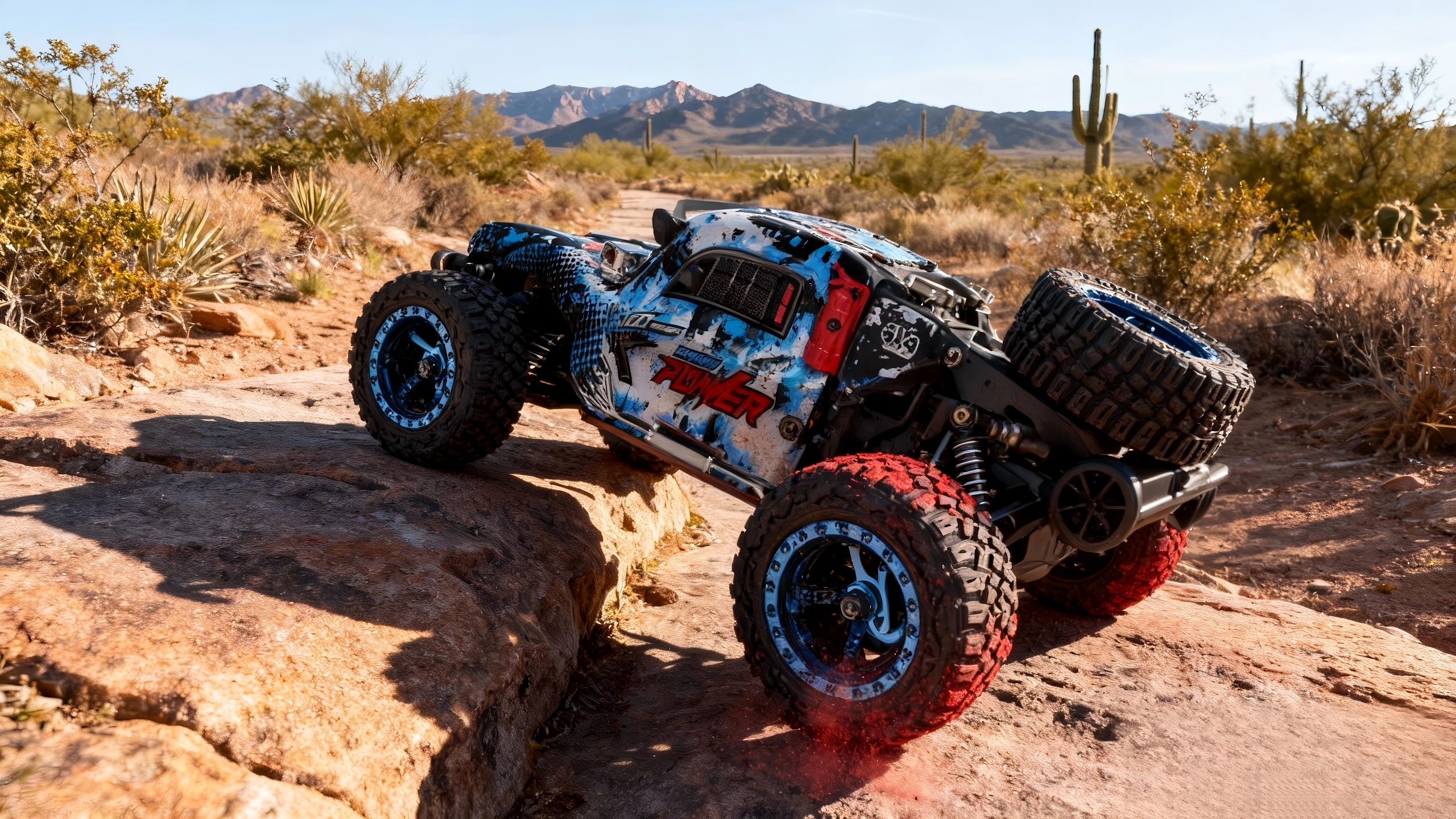
Drag brake applies braking force whenever your throttle returns to neutral, letting your truck hold position on steep descents and pauses. Many crawler ESCs default to a high drag-brake value for exactly this reason. A common starting point for dedicated crawling is to set drag brake near 100% and work down only if you notice front flips or jerky stops. Manufacturer guidance supports this approach, including the notes on drag brake and hill-hold in Castle’s Hill Hold documentation and examples in Axial platform manuals that show factory high drag-brake settings for crawler use.
Here’s a quick 8-step sequence to dial in slow-speed control:
-
Calibrate the ESC to your radio so neutral, full throttle, and full brake are learned correctly.
-
Set drag brake high for crawling (often near 100%).
-
Map an AUX knob or switch to drag brake if your ESC supports on-the-fly adjustment.
-
Enable a gentle throttle curve for smoother starts from zero.
-
Test on a 20–30° ramp. If it rolls backward at neutral, increase drag brake or check axle reductions.
-
After one to two minutes of crawling, touch-test or use a temp gun on motor and ESC.
-
If temps are climbing quickly, increase overall reduction (bigger spur or smaller pinion) and re-test.
-
If the truck still creeps on steep holds, consider enabling a low Hill Hold setting and retest.
For AUX mapping and feature references, see the Mamba X series Driver’s Ed guide from Castle and their newer Cobra series notes in Castle’s driver documentation and feature overview.
Gearing without overheating
Here’s the deal: gear changes are powerful, but heat is the tax you pay for risky choices. Start with stock gearing, change a single variable at a time, and collect quick temperature data before committing.
-
Test method: Make one small change—add one pinion tooth or increase spur by 8–12%. Crawl for about five minutes. Check temps every 60–90 seconds and stop if the motor nears 200°F / 93°C. This staged approach is consistent with guidance on gearing and thermal load in Castle’s tech blog on avoiding overheating.
-
What rising temps mean: If the motor or ESC heats fast at low speed, you’re likely overgeared or have binding. Higher numerical final reduction (bigger spur, smaller pinion) changes the equation in your favor for crawling.
-
Gear mesh and driveline: Ensure mesh isn’t too tight and that bearings spin freely. Castle’s Motor User Guide provides general mesh and airflow practices, see Castle’s motor guide.
Axles and clearance
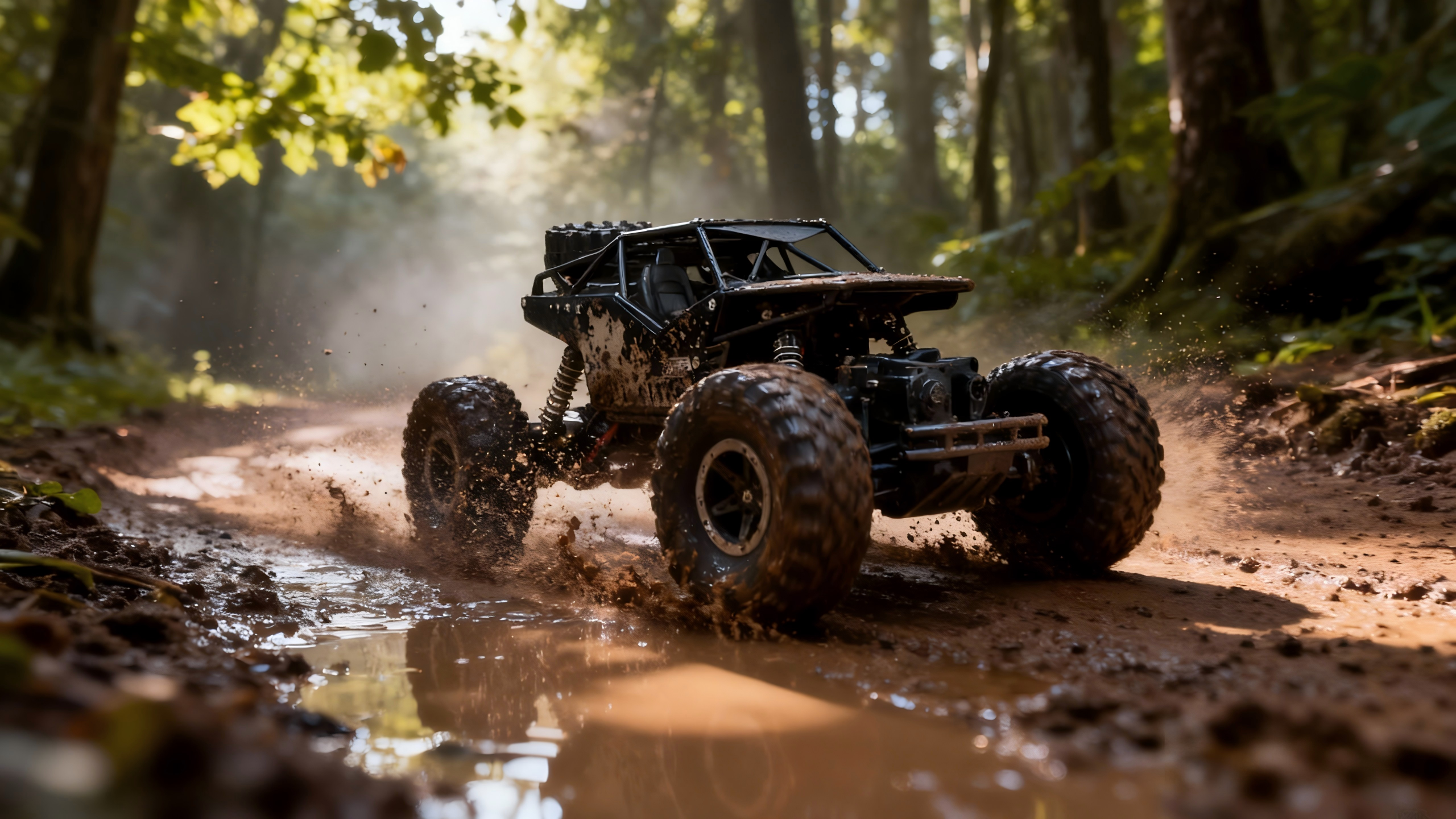
Two popular reduction styles show up a lot in crawlers teens love to carry around and film: portal axles and worm axles.
-
Portal axles add reduction at the hubs and raise the differential housing for more belly clearance. The added clearance helps approach larger rocks without high-centering, as summarized in the portal axle reference and echoed in manufacturer pages like Axial’s SCX10 III portals.
-
Worm axles, commonly used on micro crawlers, offer compact packaging and a natural resistance to back-driving, which helps trucks hold position on steep descents. Axial’s SCX24 Toyota 4Runner specs indicate worm gears front and rear; see Axial’s SCX24 4Runner product page.
Trade-offs are real: portals can add unsprung weight and complexity; worm drives may require attentive lubrication and can feel less “free-rolling.” Rather than chasing one “best” choice, match the axle style to your terrain and scale.
Waterproof vs water-resistant and post-run care
Most RTR crawlers marketed as waterproof are really splash-ready. Treat water like an optional spice, not the main course. Manufacturer manuals often warn against submersion, recommend avoiding salt water, and outline post-run care: rinse with fresh water, dry thoroughly, and re-lube metal parts. Horizon and Spektrum documentation reinforce these points, including Reliakote-coated receivers labeled water-resistant rather than fully submersible. See examples in Horizon’s boat manual water guidance, another Horizon manual example, and Spektrum’s SR6200A receiver page.
Practical guidelines:
-
Prefer shallow splashes and brief fording. Keep LiPos and connectors out of direct spray where you can.
-
After wet use, fresh-rinse, air-dry, and re-lube bearings and metal links. Check receiver box seals.
-
Avoid salt and dirty water. If you encounter either, clean immediately.
Picking your first alloy crawler
A quick comparison to help you match goals and budget. Focus on axle style, motor type, drag-brake support, and any water-ready claims noted by manufacturers.
|
Model |
Scale |
Axle style |
Motor |
Drag brake support |
Water claim |
Source |
|---|---|---|---|---|---|---|
|
Axial SCX24 Toyota 4Runner RTR |
1/24 |
Worm gears |
180-size brushed |
Yes, crawler ESC |
Water-resistant electronics |
Axial SCX24 4Runner |
|
Traxxas TRX-4M with 2-speed upgrade |
1/18 |
Straight axles |
370-size brushed |
Yes, with compatible ESC |
Model-dependent water-resistant claims |
TRX-4M 2-speed overview |
|
UDI RC UCX24 |
1/24 |
Portal-style variants exist |
Brushed |
Yes on RTR ESC |
Splash-ready claims vary by SKU |
AMain UCX24 |
|
Furitek CR-18P Rushmore |
1/18 |
Straight axles |
Brushless low-KV |
ESC drag-brake features |
Water-readiness varies |
AMain Furitek CR-18P |
Notes: Always verify the exact manual for water guidance. If choosing brushless in a micro crawler, pay extra attention to conservative gearing and temperatures.
Practical example for a compact 1:18 alloy crawler
Disclosure: Playpulse RC is our product. Here’s a neutral example to show how a small alloy crawler can fit a weekend family trail.
A 1:18 alloy crawler with 4WD, conservative gearing, and a high drag-brake setting supports slow, smooth climbs over loose gravel and short, shallow splashes. A compact platform is easy to pack, film, and carry between obstacles. For a concrete reference point on size and feature set, see the TROOPS 184021 1:18 crawling truck on PlayPulse RC’s site via this contextual page: compact 1:18 crawler example. Keep your setup simple at first: brushed motor, stock tires, and a fresh, balance-charged 2S pack.
Weekend family trail challenge plan
Here’s an hour-by-hour outline you can adapt. It’s designed for a two-hour session with a short commute.
-
Arrival and warm-up: Scout a loop with two steep climbs, a side-hill traverse, and one shallow water crossing. Teens can pick camera angles while parents spot and help set safe gates.
-
Skill blocks: Run three mini sections—slow crawl up a 25–30° slope, side-hill across packed dirt, and a shallow splash across firm pebbles. Aim for smooth throttle and clean “no-touch” lines.
-
Showcase run: Film a full loop with minimal cuts so friends see the real control, not just highlights.
What to bring and what to check, at a glance:
|
Packing essentials |
Pre-run checks |
Post-run care |
|---|---|---|
|
2–3 balance-charged 2S LiPos in a LiPo-safe bag |
Radio bound, trims neutral, endpoints set |
Fresh-rinse after splashes, dry thoroughly |
|
Compact driver set and spare rod ends |
Screws, links, wheel nuts snug and free of binding |
Re-lube bearings and metal links |
|
Temp gun and a basic tool pouch |
ESC drag brake high, throttle curve gentle |
Inspect for moisture in receiver box |
|
Small towel and zip bags for wet parts |
Battery secure and wiring clear of driveline |
Store LiPos ~3.8 V/cell in a fire-safe container |
For a broader safety walkthrough that pairs well with family trail prep, see PlayPulse RC’s checklist article: 4WD RC climbing car safety checklist.
LiPo charging and handling basics
Balance-charge your packs and stick to about 1C unless the label says otherwise. Never leave charging batteries unattended or inside the vehicle, and always use a LiPo-safe bag or nonflammable container. Store around 3.8 V per cell when you’re done for the day and keep packs in a cool place. These practices are consistent with consumer safety guidance from Horizon’s beginner series and the Academy of Model Aeronautics; see Horizon’s how to charge RC batteries and the AMA’s battery care and safety notes.
Social-friendly filming tips teens actually use
Slow crawling looks best when the camera is low and close to the action. Try phone video at 60 fps, crouch to tire height, and move the camera along the line as the truck climbs. Add a few five-second clips of the same obstacle from two angles. Want a splash shot without drama? Keep water shallow and aim for a gentle ripple rather than a dunk. Which clip would you share—the one that shows a clean hold on a steep ledge, or a cartwheel because drag brake was off?
Alternatives and upgrade paths
You’re not locked into one ecosystem. At the compact end, Axial’s SCX24 series with worm gears is a favorite for ultra-slow control. Traxxas’s TRX-4M platform has broad aftermarket support and a popular two-speed upgrade, demonstrated in community coverage like the TRX-4M two-speed overview. HPI and FTX also offer competitive 1/18 options highlighted in multi-brand roundups such as AMain’s 2024 RTR list and EuroRC’s best RC rock crawlers guide. When you’re ready to step up, 1/10 rigs bring realism and upgrade headroom—just budget for stronger servos and higher-capacity packs.
Troubleshooting quick fixes
If your crawler stutters at very low throttle, recalibrate the ESC, soften the throttle curve, and check for gear mesh that’s too tight. If it overheats during slow runs, you’re likely overgeared or have driveline binding; increase reduction and inspect bearings and links. If it won’t hold on descents, raise drag brake and confirm whether your axles provide portal or worm reductions that aid holding force. These are common themes echoed across manufacturer manuals and technical blogs.
Next steps
Ready to plan your first family trail weekend with a compact, packable setup? Browse trail-capable options in PlayPulse RC’s curated category for outdoor sessions here: RC cars for outdoor adventures. Keep your goals simple—smooth slow-crawl control, safe shallow splashes, and a few great clips—and build from there.


Leave a comment
This site is protected by hCaptcha and the hCaptcha Privacy Policy and Terms of Service apply.