Wall Climbing RC Car: How Real Wall‑Climbing Without Damaging Walls Works
If you’ve ever watched a wall climbing RC car race straight up a smooth wall and wondered “How is that even possible—and will it scuff my paint?”, this guide breaks it down. We’ll explain the suction fan mechanism, which surfaces work, what runtime and USB charging you can realistically expect, and the safety habits that keep playtime stress‑free.
Key takeaways
-
Real wall‑climbing relies on a small fan that creates a low‑pressure chamber and a flexible skirt that seals to smooth surfaces; there’s no glue or magnets.
-
Smooth, clean, non‑porous surfaces like glass or glossy tile work best; rough or dusty walls leak air and weaken adhesion.
-
Expect roughly 5–10 minutes of continuous wall or ceiling play on many toy‑grade models; USB charging typically completes within tens of minutes depending on the model and charger.
-
Protect your walls by testing a low‑visibility spot first, keeping tires and the skirt clean, and avoiding weak or flaking paint.
-
Supervise younger kids, keep fingers and hair away from the intake, and be mindful of fan noise in shared spaces.
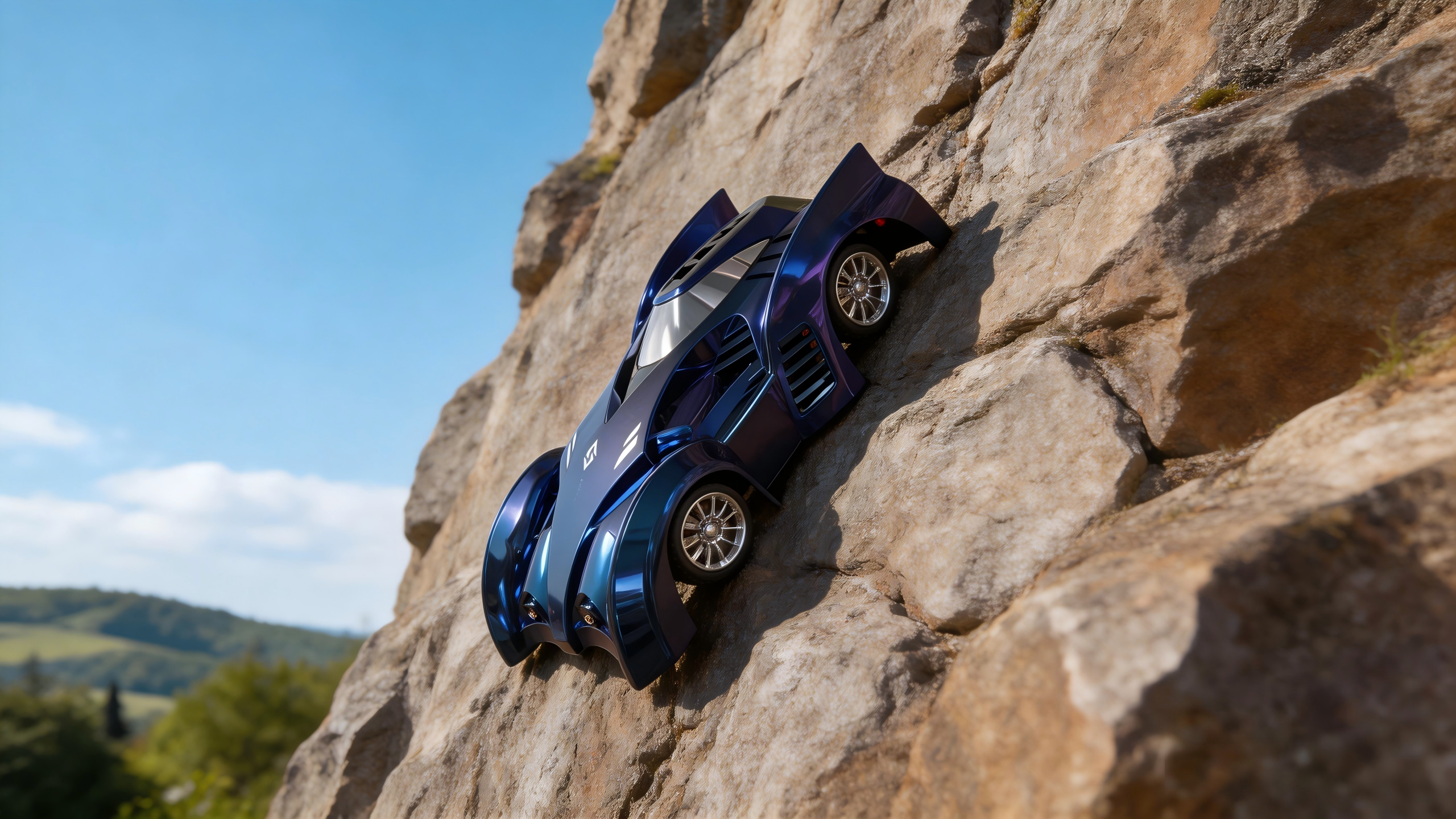
How the suction fan system works
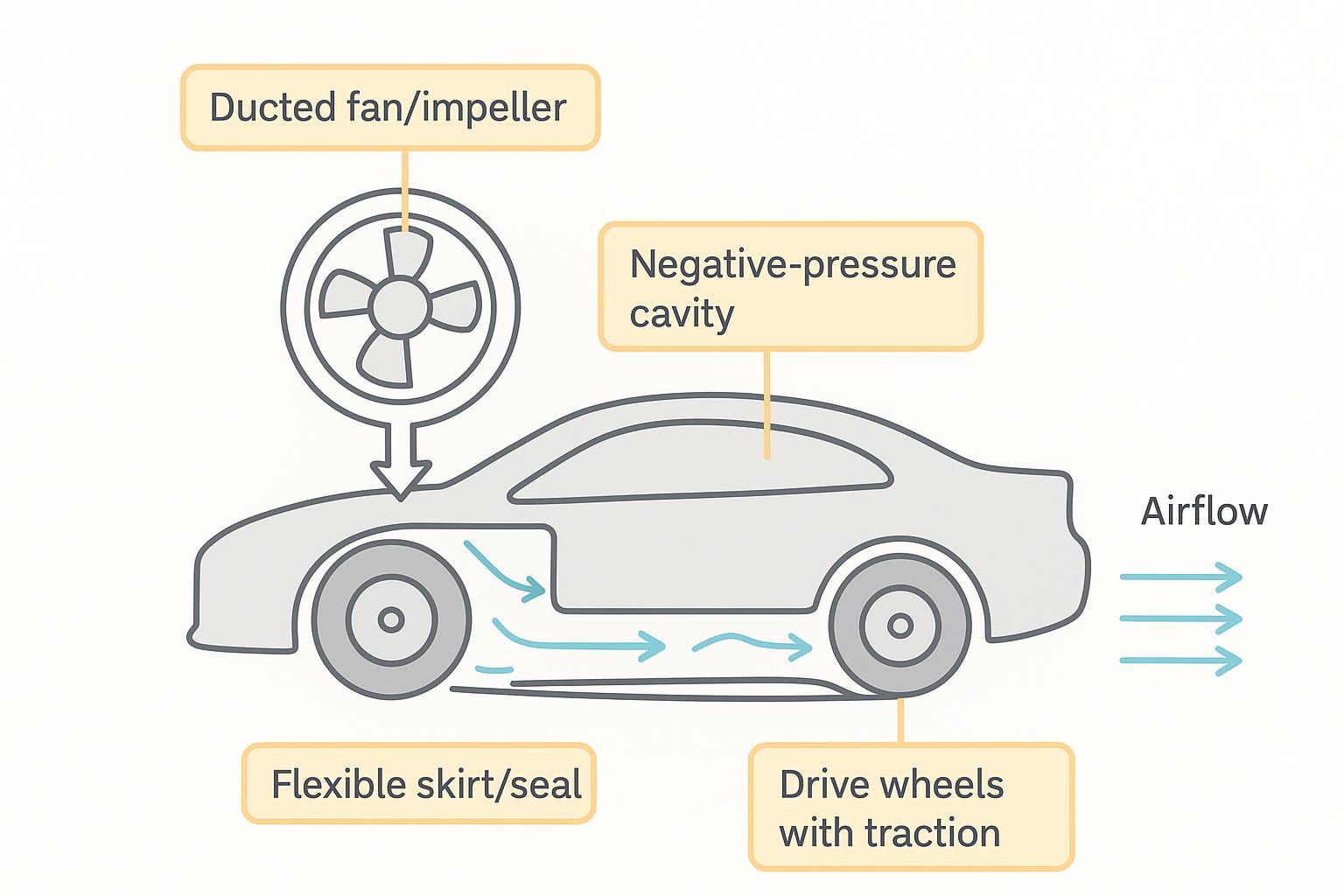
A wall climbing RC car doesn’t stick by magic. Inside the chassis is a compact, high‑speed fan that pulls air out of a shallow cavity between the car and the wall. That lowers the pressure under the vehicle so normal atmospheric pressure outside pushes the car firmly toward the surface. Drive wheels then have enough grip to move vertically.
Two design details make this practical in a toy:
-
A flexible skirt or seal around the belly of the car that conforms to tiny bumps and fills micro‑gaps, reducing air leaks.
-
A lightweight body so the fan doesn’t need extreme suction to keep the car attached.
Engineers call this approach negative‑pressure adhesion. Academic work documents how skirts improve chamber pressure and stability by cutting leakage, which is why smooth, clean walls are your friend. See the open‑access engineering discussion in the 2022 study on impeller and skirt optimization and the 2023 review of climbing robots for negative‑pressure adhesion fundamentals in consumer‑friendly terms: the skirt preserves the pressure difference, the fan maintains it, and the wheels do the driving. For background, explore the open‑access discussion of skirted sealing and pressure optimization in the 2022 impeller study and the 2023 climbing‑robot review: skirted sealing boosts negative‑pressure adhesion efficiency and negative‑pressure adhesion as a core climbing method. For a more advanced perspective on omnidirectional motion on curved walls, see the 2024 Robotica analysis of a negative‑pressure design that underscores the role of compliant sealing in dynamic maneuvers: omnidirectional negative‑pressure wall‑climbing robot analysis.
For techies: Think of the fan as a small vacuum pump and the skirt as the gasket. Leakage raises the flow the fan must move to hold a given pressure drop, which costs power and shortens runtime. Better sealing means the same fan can sustain adhesion with less energy.
Which surfaces work
Why do some walls feel like Velcro for your car while others feel like Teflon? It’s all about sealing. Smooth, non‑porous surfaces let the flexible skirt settle and hold pressure. Rough, dusty, or porous surfaces let air leak in, collapsing the pressure difference.
According to product manuals for similar vehicles, indoor operation on smooth walls and ceilings is standard, with safety guidance on engaging wall mode and keeping the intake clear. A representative source is the Sharper Image Gravity Rover instruction manual, which outlines wall and ceiling use and basic precautions; it’s a good proxy for general best practices across toy‑grade wall climbers. See this guidance in the Sharper Image Gravity Rover manual for wall and ceiling use safety notes.
Below is a practical, experience‑based compatibility matrix to set expectations. Always test a small, low‑visibility spot first.
|
Surface type |
Expected result |
Notes |
|---|---|---|
|
Glass window or door |
Excellent |
Very smooth and non‑porous; strongest seal and longest runtime. |
|
Glossy ceramic tile |
Excellent |
Great seal; mind grout lines—cross them slowly. |
|
Smooth painted drywall satin or semi‑gloss |
Good |
Works if paint is sound and clean; avoid chalky or flaking paint. |
|
Smooth painted drywall matte |
Fair |
Usable if very smooth and clean; increased leakage may reduce climb angle and runtime. |
|
Laminated wood or sealed cabinet panels |
Fair to good |
Depends on finish smoothness and dust; wipe before use. |
|
Textured paint, heavy orange‑peel, porous wallpaper |
Poor |
Air leaks through texture/pores; skirt flutters and adhesion drops. |

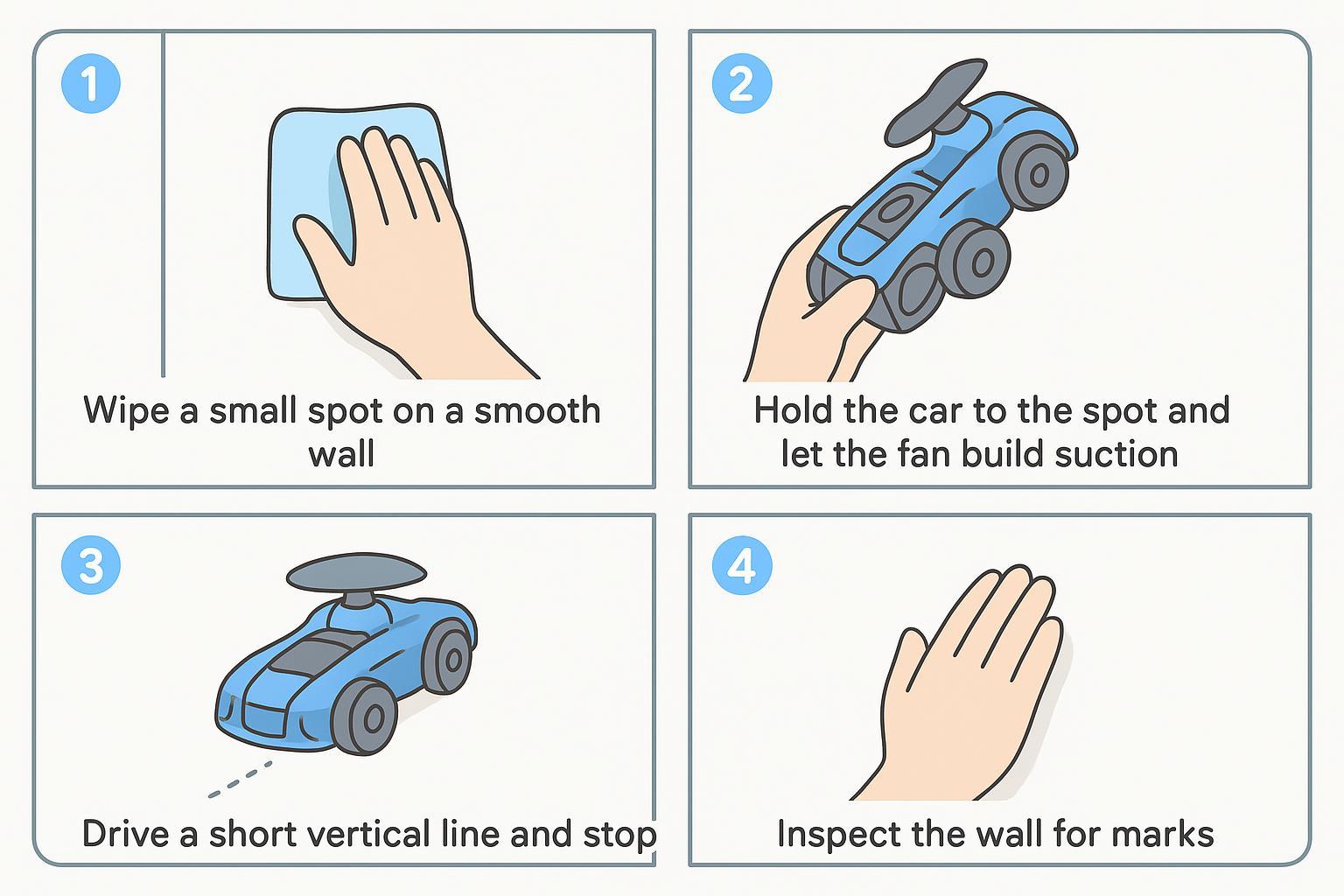
How to quick‑test a surface in under a minute
-
Wipe a small, out‑of‑the‑way spot with a dry, lint‑free cloth.
-
With the car in wall mode, hold it lightly against the spot for 5–10 seconds to let the fan build suction.
-
Drive a slow, short vertical line—about 12–18 inches—and stop.
-
Inspect the wall for marks; if you see smudges, clean the tires and try again. If the car slips or the skirt audibly flutters, choose a smoother surface.
Wall climbing RC car runtime and USB charging
Here’s the deal: keeping a fan spinning to hold the car on the wall uses energy. That’s why a wall climbing RC car typically runs for a shorter stretch per charge than a floor‑only toy.
Representative figures from a leading toy line indicate that wall‑mode sessions are short but satisfying. For example, the Air Hogs Zero Gravity Sprint is commonly listed at about eight minutes of play per charge. A major retailer’s product page states “Enjoy 8+ minutes of speedy fun on a single charge,” which aligns with many user experiences on similar suction‑fan toys. See the runtime note on the Air Hogs Zero Gravity Sprint retailer page.
So what should you expect? Roughly 5–10 minutes of sustained wall or ceiling driving per full charge is a reasonable planning range for many suction‑fan models. USB charging usually completes within tens of minutes, though exact duration varies by vehicle battery and the USB adapter’s output. Follow your model’s manual and charging LED instructions. Representative RC charging safety language—turn the vehicle off during charging and use appropriate power sources—is captured in this widely cited toy manual PDF: charging and safety instructions for RC toys.
Factors that influence playtime include:
-
Surface quality and seal integrity. More leakage forces the fan to work harder.
-
Driving pattern. Continuous vertical climbs draw more power than brief wall touches.
-
Battery age and temperature. Cooler, healthy batteries hold voltage better under load.
-
Charger output. A 5V/2A USB source can finish faster than a low‑current port; always follow the manual.
Want a touch more runtime without changing hardware? Keep surfaces and tires spotless, avoid textured walls, and plan a few short floor segments between climbs to let the fan’s load dip briefly.
Safety and maintenance essentials
When used as directed and on suitable surfaces, wall climbers are designed for safe indoor fun. Still, a few habits make a big difference.
Safety you can count on
-
Supervise younger kids, especially during ceiling driving; there’s always some drop risk if the battery dips.
-
Keep fingers, hair, and loose clothing away from the intake and wheels.
-
Choose sturdy, clean, smooth walls you’ve tested; avoid flaking paint, soft coatings, or textured wallpaper.
-
Be fan‑noise aware; schedule playtime when it won’t disturb others.
Maintenance that keeps suction strong
-
Clean the intake grille, tires, and skirt with a dry, lint‑free cloth after dusty play.
-
Inspect the skirt for tears or lifted edges; re‑secure per your model’s guidance.
-
Store the car clean and dry; keep charging ports free of debris.
-
Charge with the vehicle switched off and only with the specified cable and a suitable USB source, per your manual’s instructions.
Troubleshooting in plain language If the car won’t stay on the wall, think “seal, surface, and state of charge.” Clean the skirt and tires, pick a smoother wall, and top up the battery. If you notice smudges, wipe the tires and confirm your paint isn’t chalking. A rattly or unusually loud fan often points to a blocked intake or a loose panel—inspect before the next run. Many of these precautions echo general toy safety and use guidance described in manuals for similar products; for an example of wall and ceiling mode handling, see the Sharper Image manual’s wall‑mode guidance and warnings.
Practical example for a smooth first session
Here’s a neutral, repeatable workflow you can try at home before a big stunt session. It aligns with best practices found across many manuals and engineering explainers.
-
Prepare the test spot. Wipe a small area on a smooth interior wall. Clean the car’s tires and skirt edge.
-
Check adhesion. Hold the car gently to the wall in wall mode for a few seconds. If it feels firm and the skirt isn’t fluttering, drive a short vertical line and stop.
-
Confirm battery strength. If acceleration feels weak or the fan tone sags, recharge before trying ceilings.
You can use any comparable toy‑grade wall climber for this routine. For example, models available from Playpulse RC can be set up the same way—clean, test, then climb—without making assumptions about brand‑specific performance.
Buyer’s quick checklist
-
Mechanism: Look for a wall climbing RC car with a dedicated fan and a flexible skirt or seal.
-
Surfaces: Plan to use smooth, clean, non‑porous walls; avoid textured or failing paint.
-
Runtime: Expect about 5–10 minutes per charge for wall or ceiling mode; treat claims far beyond that with healthy skepticism unless backed by a clear test method.
-
Charging: USB charging usually finishes within tens of minutes; follow your manual’s LED indicators and keep the vehicle off while charging.
-
Safety: Supervise younger kids, manage fan noise, and test surfaces in a low‑visibility spot first.
References and further reading
-
Skirt efficiency and negative‑pressure adhesion in wall climbers: open‑access 2022 impeller and skirt optimization study
-
Negative‑pressure adhesion overview within climbing‑robot technologies: open‑access 2023 review of climbing robots
-
Advanced design perspective on negative‑pressure robots: Robotica 2024 omnidirectional wall‑climber analysis
-
Typical wall‑mode runtime on a popular toy line: Air Hogs Zero Gravity Sprint retailer listing
-
Representative toy RC charging and safety instructions: general RC charging and safety PDF