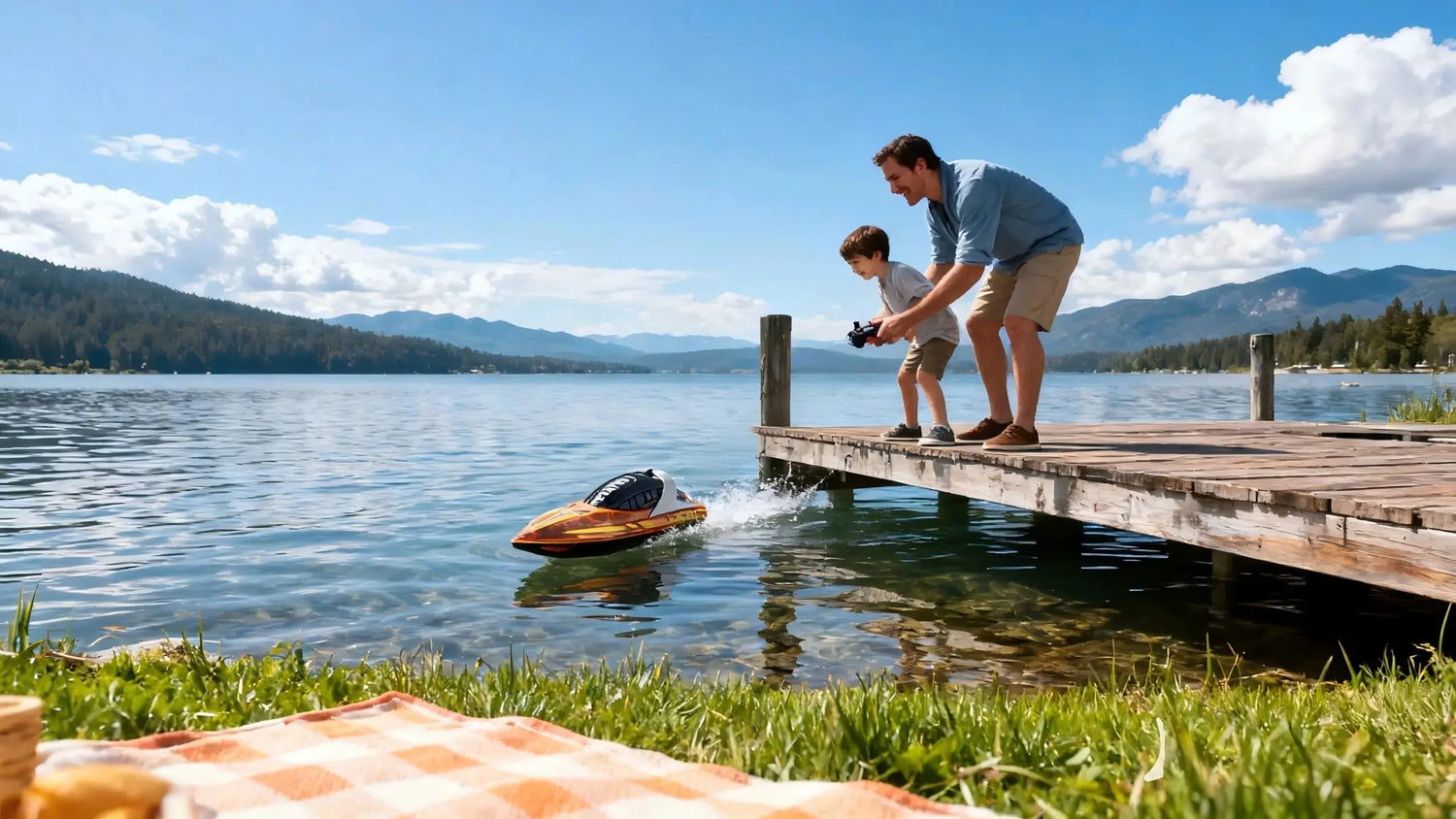
RC Boats for Kids (2026): Brushless vs Brushed, Freshwater vs Saltwater, and Speed vs Runtime
Parents shopping for a first (or next) RC boat for ages 6–12 face three big trade-offs: brushless vs brushed RC boat motors, freshwater vs saltwater use, and speed vs runtime. This guide keeps things safety-first and kid-friendly. Version scope: electric RTR boats commonly sold 2024–2026; information current as of 2026-03-08. Prices and features vary by retailer and are subject to change.
Key takeaways
-
For kids 6–8 in pools, start with brushed or low-power brushless and look for self-righting, 2.4GHz anti-interference, and water-activation prop safety.
-
For 9–12 in ponds/lakes, beginner brushless is fine if you enable training/dual-rate modes and supervise.
-
Freshwater is the default. Saltwater only if the manual explicitly allows it—and always rinse, dry, and re-lube right after use, per official brand manuals.
-
Typical playtime per battery is about 10–15 minutes at mixed throttle; bring spare packs and coach moderate throttle for longer sessions.
Short on time? Here’s the gist: pick by venue and age. Brushed or mild brushless for 6–8 in pools; beginner brushless deep‑V with self‑righting for 9–12 in ponds/small lakes; use saltwater only on boats rated for it and commit to thorough post‑run care. For the longest runtime, carry two batteries and cruise more than you sprint.
Quick comparison table: motor type, water type, and playtime focus
|
Category |
Best age/venue |
Safety & ease-of-use highlights |
Typical top speed |
Typical runtime (one pack) |
Maintenance load |
Typical price (US) |
Best for |
|---|---|---|---|---|---|---|---|
|
Brushed starter (freshwater) |
6–8; pools and calm ponds |
2.4GHz radios common; many kid boats add water-activation prop safety and some include low-battery alerts; self-righting on select models |
Slower; often below 20 mph |
~10–15 min mixed throttle |
Low: wipe dry; periodic shaft grease |
~$30–$150 (as of 2026‑03‑08) |
First RC boat; youngest users under close supervision |
|
Beginner brushless (freshwater) |
9–12; calm ponds/small lakes |
Self-righting deep‑V hulls popular; 2.4GHz multi‑boat play; some ESCs offer training/dual‑rate modes |
~20–30+ mph (size/prop dependent) |
~10–15 min typical; more with larger packs/moderate throttle |
Low–medium: routine dry + grease |
~$100–$350+ (as of 2026‑03‑08) |
Older kids who want more speed with safety features |
|
Freshwater default |
6–12; pools/ponds/lakes |
Lowest corrosion risk; easier care |
— |
— |
Low |
— |
Everyday family boating |
|
Saltwater‑rated only |
9–12 with adult help; calm bays |
Use only models the manual says are saltwater‑capable; rinse, dry, and re‑lube after every run |
— |
— |
High: full rinse/dry/lube after each session |
— |
Occasional beach days with diligent maintenance |
|
Longest‑runtime focus |
6–12; any calm water |
Spare packs; moderate throttle; efficient props; right‑size battery |
Any |
15–25 min possible with larger capacity and cruising |
Low–medium |
Battery/charger budget matters |
Play longer without chasing pure top speed |
Notes: Speed and runtime vary by hull, battery capacity, prop, and driving style. Always confirm the manual for features like self‑righting, saltwater suitability, and safety circuits.
Brushless vs Brushed RC boat motors for kids
If you’re weighing brushless vs brushed RC boat options for a child, start with safety and controllability, not just top speed. Brushless motors are more efficient and deliver higher torque than brushed units at the same voltage, which is why many beginner brushless boats can reach 20–30+ mph. A 2025 speed overview from ExHobby describes this recreational range and why hull and prop choices matter in practice—see the publisher’s explainer on how fast RC boats go (2025): ExHobby’s speed overview.
For younger kids, slower can be better. Brushed setups are cheaper, simpler, and usually slower—great for small pools and first‑time controls. Brushless can still be appropriate for 9–12 as long as you enable any training modes or dual‑rates, pick calmer water, and supervise. Some beginner guides also point families toward self‑righting hulls and even jet‑pump designs (no exposed prop) for extra safety; a 2025 retailer overview highlights these features: RC Visions beginner guide.
Runtime is a wash at kid speeds. Because brushless is more efficient, a brushless boat cruising at half throttle can match or beat a brushed boat’s effective playtime; at full throttle, both will drain packs quickly. Real‑world reviews of small jet boats, such as this 2024 test, report around 15 minutes at full tilt and roughly 20 minutes with mixed driving—useful baselines for family expectations: The Gadgeteer DE95 review.
Cost and longevity: brushed wins on upfront price; brushless often wins on long‑term durability (no brushes to wear) and keeps excitement high for older kids. Many families start brushed for ages 6–8, then upgrade to brushless when skills and venues expand. Think of it like moving from a balance bike to a pedal bike with gears—same idea, just on water.
Freshwater vs Saltwater RC boat use
Freshwater is simpler, safer for electronics, and faster to clean. Saltwater, on the other hand, accelerates corrosion. If you plan beach or bay days, only run a model the manual explicitly states is saltwater‑capable, and budget time for care. An official brand manual details best practices after any run: open the hatch, let components dry, relubricate the shaft, and avoid high‑pressure sprays that can force water into seals: Pro Boat Recoil 2 Brushless RTR Manual (2024). Beginner‑oriented guides likewise flag that saltwater requires immediate rinsing, drying, and re‑greasing or you’ll shorten the boat’s life.
A few family tips that go a long way: keep a freshwater spray bottle and microfiber towels in your gear bag; after saltwater runs, rinse hull and hardware thoroughly, let everything dry with the hatch open, and re‑grease moving parts the same day; and don’t assume warranties cover saltwater damage unless the manual allows saltwater.
Also note: many kid‑oriented boats add water‑activation prop safety (the prop only spins when the boat is in water), a feature described in kid guides from mainstream toy brands (2026).
RC boat speed vs runtime: how to set expectations
Here’s the deal: most entry‑level boats deliver about 10–15 minutes of mixed‑throttle play per battery. Full‑throttle runs cut that down; cruising stretches it out. A 2024 review of a small jet boat clocked ~15 minutes at continuous high speed and closer to 20 minutes when mixing in cruising and turns—right in line with many retailer primers: The Gadgeteer DE95 review.
What actually changes runtime for kids? Battery capacity and type, throttle habits, prop/hull efficiency, and motor KV. A hobby battery primer from a major retailer outlines how capacity and discharge demands interact: Hearns Hobbies’ LiPo selection primer (2025). For parents, the takeaway is simple: two batteries and a sensible cruise pace keep the fun going without overheating or pushing past battery safety limits. Teach kids to return to shore at the first low‑battery beep—many kid‑friendly transmitters include an alert.
Safety checklist and first‑run onboarding for ages 6–12
-
Confirm the radio is 2.4GHz so siblings can run together with minimal interference. Do a quick range check at the venue.
-
Look for self‑righting hulls so a capsize doesn’t end the day. Practice a gentle self‑righting maneuver close to shore.
-
Prefer boats with water‑activation prop safety and, where available, low‑battery alerts on the transmitter.
-
Start in a pool or small, calm pond. Add chop and distance only as confidence builds.
-
Supervise closely, enforce a “no hands near the prop” rule, and use training/dual‑rate modes if offered by the ESC or transmitter.
For explanations and examples of these beginner‑friendly features, see a 2025 retailer guide to first boats that calls out self‑righting and jet‑pump safety, and a 2026 kid brand guide that describes water‑activation circuits: RC Visions beginner guide and Dickie Toys beginner’s guide (2026).
How to choose: quick scenarios
For a 6–8‑year‑old using a backyard pool, a brushed beginner boat (or a low‑power brushless) is the easiest path. You’ll get calmer speeds, a gentler learning curve, and straightforward care. Add self‑righting if possible to reduce pool‑retrieval drama.
For a 9–12‑year‑old at a calm pond or small lake, pick a beginner brushless deep‑V that lists self‑righting and a transmitter low‑battery alert. Keep a hand on training/dual‑rate settings for the first few outings to tame acceleration.
If saltwater time is non‑negotiable, run only boats whose manuals explicitly allow it. Plan for immediate rinse, dry, and re‑lube after each session and expect higher maintenance over the season.
Chasing longer playtime? Carry two charged packs and cruise more than you sprint. If you want to level up later, move from brushed to brushless and add capacity step by step rather than jumping straight to maximum speed.
FAQ
Which motor type is safer for kids: brushed or brushless?
Brushed is typically calmer and easier for first‑timers in small pools. Brushless can be safe for 9–12 with supervision if you enable training modes and pick a self‑righting hull. The real safety win is features: 2.4GHz control, water‑activation prop safety, self‑righting, and clear low‑battery alerts.
Can I run an RC boat in saltwater? What maintenance is required?
Only if the manual says the model is saltwater‑capable. After every saltwater session, rinse thoroughly with freshwater, open the hatch to dry, and relubricate moving parts the same day. These steps reflect official maintenance procedures in brand manuals, which warn that salt accelerates corrosion.
How long will a typical kids’ RC boat run per charge?
About 10–15 minutes at mixed throttle for entry‑level packs. Larger batteries and gentler cruising can extend this, while prolonged full‑throttle runs will shorten it. Plan on two packs per child for stress‑free outings.
Is a brushless RC boat too fast for a 6‑year‑old?
Usually, yes—at least at full power. For ages 6–8, choose brushed or enable strict training limits on any brushless model, stick to pools or very small ponds, and supervise closely.
What safety features should I check before buying?
Look for 2.4GHz radio control, self‑righting hulls, water‑activation prop safety, and low‑battery alerts. If multiple kids will play, ensure each boat can operate simultaneously without interference and that you can limit throttle for beginners.
Also consider Playpulse RC
If you value family‑friendly policies alongside kid‑safe features, Playpulse RC offers a 6‑month warranty and 30‑day returns for defects, which can reduce ownership stress for parents. Explore the brand’s family‑oriented lineup here: Playpulse RC remote control boats.
Sources and further reading
-
For official post‑run care and saltwater cautions, see Horizon Hobby’s Pro Boat Recoil 2 manual (2024), which details drying and lubrication steps after operation: Pro Boat Recoil 2 Brushless RTR Manual.
-
For beginner‑friendly features like self‑righting hulls and jet‑pump safety, see a retailer’s overview: RC Visions beginner guide to first RC boats (2025).
-
For typical recreational speeds and why hull/prop matter, see: ExHobby’s “How fast do RC boats go” (2025).
-
For real‑world runtime context on a small jet boat, see: The Gadgeteer’s DEERC DE95 review (2024).
-
For battery capacity and discharge basics that affect runtime, see: Hearns Hobbies’ LiPo selection primer (2025).