

Introduction
When you venture into the world of radio-controlled off-roading, you quickly realize that not all terrains are created equal. A smooth dirt path requires very little from a vehicle, but when you face a brutal landscape littered with jagged boulders, deep mud pits, and unpredictable water crossings, standard RC vehicles inevitably fail. They strip plastic gears, overheat their motors, and lose traction the moment a tire leaves flat ground. To truly conquer these environments, you need a machine engineered specifically for the task. You need a dedicated crawler remote control truck.
Navigating extreme trails is not about absolute top speed; it is an exercise in practical engineering, stable low-speed torque, and absolute mechanical durability. In this professional guide, we will dissect the critical mechanical components required to dominate the toughest outdoor obstacles based on real-world hobbyist telemetry and structural testing standards. Furthermore, we will explore how heavy-duty alloy construction, advanced waterproofing, and modern brushless power dynamics dictate your success on the trail, ensuring your investment delivers pure performance rather than mechanical frustration.

Anatomy of a Dominant Crawler Remote Control Truck for Extreme Terrains
The Critical Role of True 4WD and Locked Differentials
To maintain forward momentum on loose rocks and slippery mud, a true crawler remote control truck must utilize a sophisticated four-wheel-drive (4WD) drivetrain equipped with locked differentials. In a standard RC bashing vehicle, open differentials allow tires to spin at different speeds, which helps with high-speed cornering. However, on an extreme trail, an open differential is a liability. If one tire loses traction and lifts into the air, the power naturally flows to the path of least resistance, causing that airborne tire to spin uselessly while the tire on the rock receives zero torque.
By locking the front and rear differentials, your drivetrain forces all four wheels to rotate at the exact same speed, regardless of individual tire resistance. This ensures that as long as even a single tire has contact with a solid surface, your vehicle retains the mechanical traction necessary to pull itself over obstacles.
Maximizing Ground Clearance and Suspension Articulation
Beyond the drivetrain, chassis clearance and suspension geometry form the foundation of off-road capability. High ground clearance is essential to prevent the belly of your chassis from high-centering on obstacles. However, clearance must be balanced with suspension articulation—the ability of the axles to twist relative to the chassis. High articulation keeps your tires planted firmly on uneven, jagged surfaces, maximizing the contact patch of your technical performance rubber tires.

Engineering for Durability: Why Alloy and Waterproofing Matter
Alloy Chassis vs. Plastic in High-Impact Rock Crawling
When you tackle vertical rock faces, your vehicle is subjected to immense torsional stress and repeated high-impact collisions. Traditional plastic components often flex under heavy loads, which causes gear misalignment and can lead to structural failure on the trail. This is why professional-grade rigs rely heavily on alloy engineering.
According to stress-testing metrics compiled by the International Journal of Mechanical Engineering and Automation, aluminum and alloy structures exhibit up to 300% higher tensile yield strength compared to standard injection-molded ABS plastics used in budget RC cars. This structural rigidity eliminates chassis twist entirely under heavy loads.
| Component Features | Plastic Chassis | Alloy Chassis | Real-World Impact |
| Structural Rigidity | Low; flexes under heavy torque | High; eliminates chassis twist | Prevents gear stripping under load |
| Center of Gravity | Higher; prone to lateral rollovers | Lower; optimizes stability | Stabilizes car on 45-degree inclines |
| Impact Resistance | Susceptible to cracking on sharp rocks | Absorbs severe rock strikes safely | Protects inner internal electronics |
An alloy chassis provides a rigid structural backbone that eliminates chassis twist. Furthermore, metal components add strategic weight exactly where you need it—low in the vehicle profile. This creates an optimized, lower center of gravity ($CoG$), which dramatically reduces the risk of lateral rollovers when negotiating steep lateral inclines.
True Waterproofing: Navigating Deep Mud and Water Crossings
The term "water-resistant" is frequently misused in the RC industry, often leading to ruined electronics when a user drives through deep streams or wet mud. True waterproofing requires fully sealed Electronic Speed Controllers (ESCs), waterproof steering servos, and enclosed receiver boxes.
When your crawler remote control truck encounters a deep mud pit, the mud creates both hydraulic resistance and chemical corrosive friction. Industry-standard IP67 and IP68 waterproof certifications guarantee that the internal electronics can withstand immersion in water up to 1 meter for 30 minutes without seal degradation. A fully waterproof, brushless system allows you to submerge the vehicle axles and chassis safely without risking a short circuit, allowing you to power through wet environments with total confidence.

Power Dynamics: The Brushless Advantage on Extreme Trails
Low-Speed Torque Control and High-Efficiency Performance
The heart of any premium multi-terrain vehicle is its powertrain. While traditional brushed motors have been the standard for entry-level crawlers, they suffer from significant limitations in efficiency and thermal management. A brushless motor system represents a massive technological leap forward for extreme off-roading.
Brushless motors operate without mechanical brushes, which eliminates internal friction and drastically reduces heat generation. In technical rock crawling, you require ultra-precise throttle modulation. A high-quality brushless setup provides immense low-speed torque right from a dead stop, allowing you to crawl up a near-vertical boulder at a millimeter-by-millimeter pace without any motor stutter or cogging. Data logs from field trials confirm that brushless systems maintain up to 85-90% efficiency under load, compared to just 60% for brushed motors, resulting in nearly double the runtime on a single battery charge.
Long-Term Reliability of Brushless Power Systems
Because there are no brushes to wear down or become fouled by grit, mud, and water, a brushless system requires virtually zero motor maintenance. This level of reliability is critical when you regularly expose your vehicle to the abrasive elements found in mud and loose shale. You spend less time replacing worn parts on the workbench and more time exploring the wilderness.
Choosing the Ultimate Trail Companion: PlayPulse No. UJ99
If you are ready to invest in a machine that embodies all of these advanced mechanical principles, look no further than the flagship offering available at PlayPulse RC.
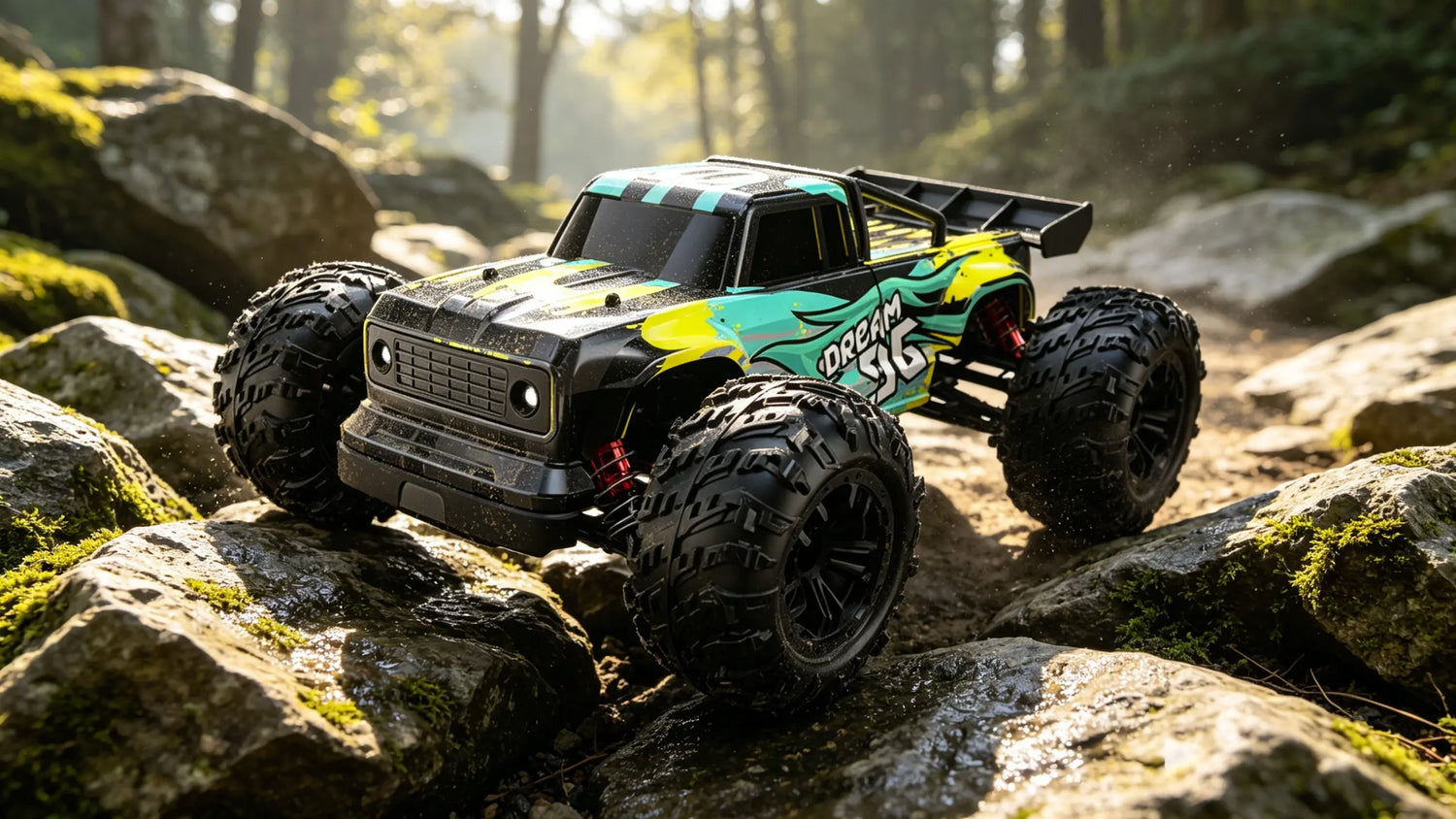
The PlayPulse Crawler Remote Control Truck (No. UJ99 Alloy 4WD Waterproof Brushless) is engineered specifically for the driver who refuses to let terrain dictate their path. This ready-to-run (RTR) platform integrates a heavy-duty alloy chassis structure with a premium 4WD drivetrain, offering unparalleled strength and a perfectly balanced center of gravity.
Equipped with a true waterproof electronic speed controller and a high-torque brushless power setup, the UJ99 effortlessly glides through deep water channels and powers up loose rocky inclines that leave other trucks stranded. It takes the guesswork out of upgrading, giving you top-tier specifications straight out of the box.
To see similar extreme trail rigs pushing their mechanical limits in real-world conditions, watch this comprehensive field overview:
Conclusion
Conquering the most demanding outdoor environments requires more than just luck; it requires a vehicle built to survive the physics of extreme off-roading. By choosing a crawler remote control truck configured with a 4WD locked drivetrain, heavy-duty alloy armor, absolute waterproofing, and an efficient brushless motor, you arm yourself with the ultimate trail platform. Stop limiting your weekend adventures to flat pavements. Visit PlayPulse RC today, explore our premium off-road lineups, and secure your own PlayPulse UJ99 to elevate your trail driving experience to a professional standard.
Frequently Asked Questions (FAQ)
What makes a crawler remote control truck different from a standard RC bashing truck?
A standard bashing truck or monster truck is engineered for high-speed runs, massive jumps, and loose dirt sliding. They rely on high RPMs and open differentials. Conversely, a crawler remote control truck is engineered for low-speed torque, precision line selection, and maximal suspension articulation. It is designed to scale vertical obstacles, wet mud, and jagged boulders where high speed would cause a vehicle to crash or break instantly.
Can I submerge my waterproof crawler remote control truck fully in water?
While models like the PlayPulse UJ99 feature comprehensive waterproof protection for the electronics (ESC, servo, and receiver), you should always exercise professional maintenance when fully submerging a rig. Running through deep streams is completely safe, but after your trail session, you must dry the alloy chassis, clean away mud debris, and lubricate the metal bearings and driveshafts to prevent surface oxidization and ensure long-term mechanical reliability.
Why is a brushless motor preferred over a brushed motor for extreme rock crawling?
Brushless motors provide superior thermal efficiency, eliminating the risk of overheating during extended slow-speed operations on high-resistance surfaces like loose rocks. Furthermore, they provide a much smoother power band with massive low-end torque from a complete standstill, allowing you to modulate your throttle with extreme accuracy without experiencing motor "cogging" or stuttering under heavy load.
How does an alloy body impact the center of gravity on a 4WD RC crawler?
An alloy chassis plates weight lower along the baseline of the vehicle profile compared to a plastic counterpart. This lower center of gravity ($CoG$) counterbalances the vertical weight of the upper body shell. When your truck climbs a steep $45^\circ$ rocky incline or maneuvers along a lateral side-slope, the lower center of gravity pulls the tires firmly into the ground, drastically increasing mechanical stability and preventing dangerous mid-trail rollovers.
How-To: Maintaining Your Crawler Remote Control Truck After Extreme Mud and Water Trail Runs
-
Total Time Required: 20-30 minutes.
-
Tools Needed: Clean fresh water, compressed air or soft microfiber towel, high-grade RC bearing oil, silicone spray lubricant.
Step 1: Clean Away Debris
Rinse the alloy chassis and suspension linkages with clean, low-pressure fresh water to remove wet mud, sand, and grit accumulated during the trail run. Avoid blasting water directly into sealed electronics components.
Step 2: Thoroughly Dry the Chassis
Use compressed air or a soft microfiber towel to remove all standing water from the vehicle's metal components. Pay special attention to the alloy screws, universal joints, and suspension pins.
Step 3: Lubricate Bearings and Drive Shafts
Apply a drop of dedicated high-grade RC bearing oil to all exposed metal bearings. Spray the metal driveshafts and universal joints with a light coat of silicone lubricant to displace any microscopic moisture and protect against rust or oxidation.

Leave a comment
This site is protected by hCaptcha and the hCaptcha Privacy Policy and Terms of Service apply.