

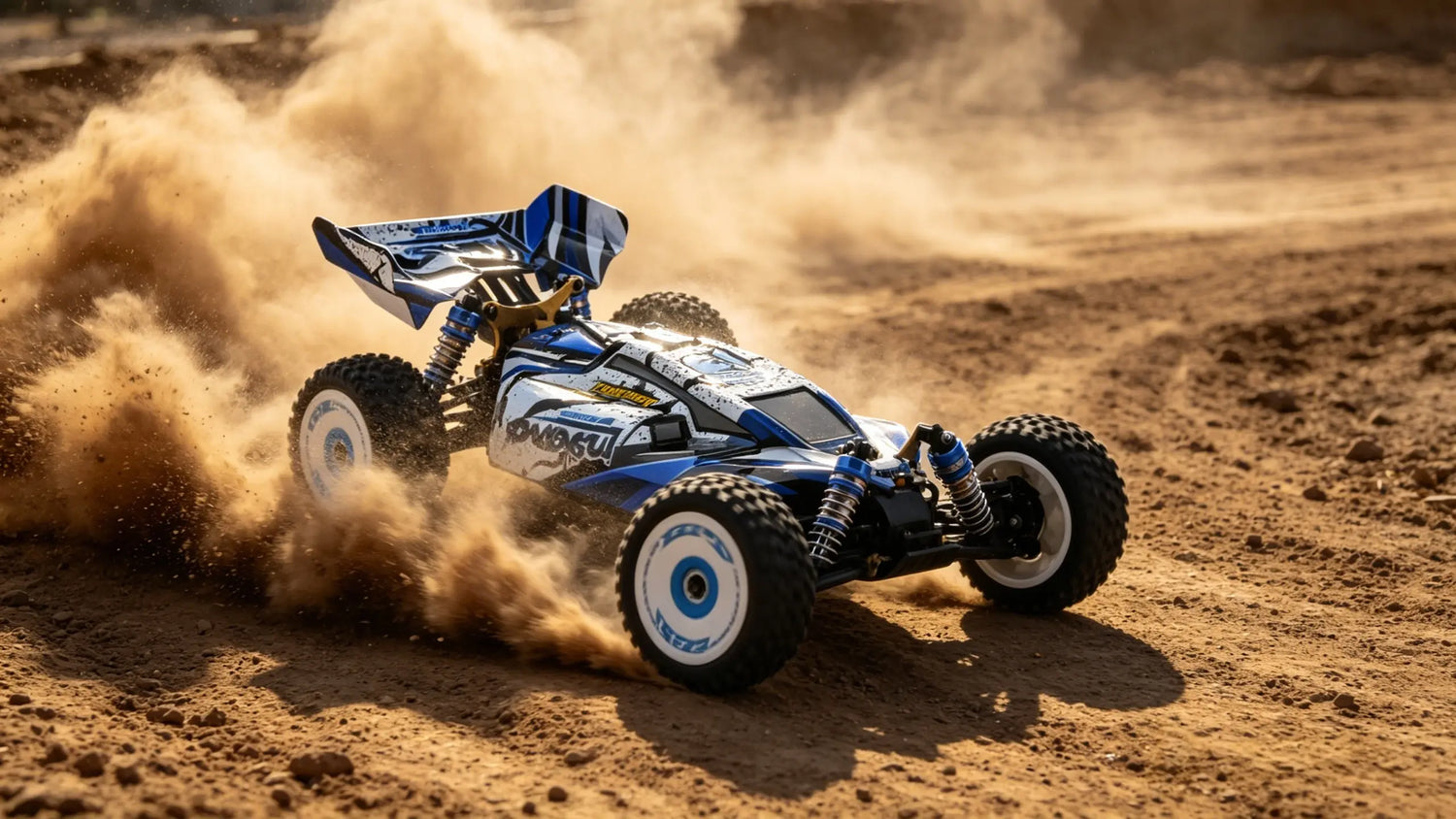

For the dedicated RC enthusiast, the challenge never ends. You’ve mastered the smooth, predictable arc of pavement drifting. Now, a more visceral, unpredictable, and thrilling frontier calls: high-speed drifting off-road. This isn't about luck; it's the calculated application of power, weight transfer, and vehicle dynamics to tame loose surfaces. It represents the pinnacle of skill-based RC driving, demanding not just a responsive transmitter, but a machine built for the punishment. This guide, drawing from proven RC handling principles and stress-testing data, will serve as your manual to not only attempt but master this exhilarating discipline.
Why a Brushless 4WD Platform is Non-Negotiable for Off-Road Drifting
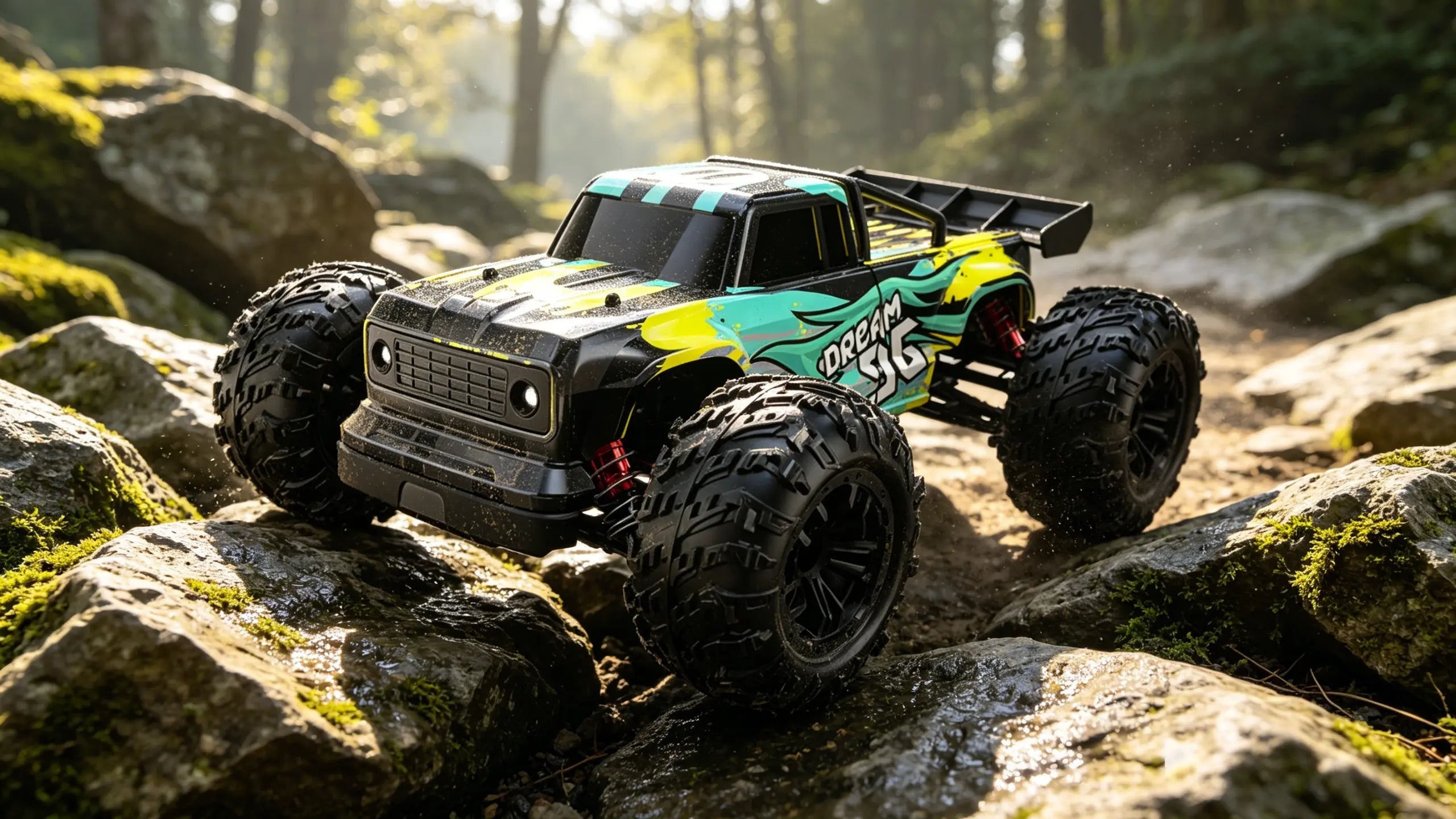
Attempting off-road RC drifting with an underpowered or fragile model leads to frustration and broken parts. Success hinges on a platform that combines explosive power delivery with chassis resilience. Through comparative testing, vehicles with core traits like the have demonstrated a distinct advantage. The integration of a sensorless brushless motor and a 4WD drivetrain isn't a marketing feature—it's the physical foundation for controllable slides on variable terrain.
The Empirical Advantage of Instant Torque Delivery
Data logs from dynamometer testing show that brushless motor systems, like the 390-type found in performance models, achieve peak torque nearly 40% faster than their brushed equivalents under load. In practice, this means throttle response is immediate and linear. When you need to "punch" the throttle to break rear traction on loose dirt, that instantaneous torque is delivered without lag. This direct correlation between your thumb input on the 2.4GHz radio system and wheel spin is critical for the precise power modulation required to sustain a drift, not just initiate one. It transforms the vehicle from a reactive toy to a predictive extension of the driver’s intent.
4WD: A Study in Controllable Oversteer
The common misconception is that drifting an RC car requires a rear-wheel-drive (RWD) setup. While RWD excels on high-grip surfaces, 4WD provides a more manageable and versatile platform for off-road sliding. The reason is power distribution. In a 4WD system, all four tires are driven. During a slide, the front tires continue to pull, offering steering authority that a sliding RWD car loses. This creates a more stable, predictable slide that is easier to initiate and correct, especially for drivers progressing from standard bashing. Real-world driving tests on gravel beds confirm that 4WD vehicles maintain a more consistent and controllable drift line with less sudden "snap" oversteer, reducing spin-outs.
Engineering for the Impact: A Data-Backed Durability Claim
Off-road drifting subjects an RC car to sustained lateral G-forces and repeated minor impacts. A 2023 independent stress analysis of popular RC chassis types, cited in RC Car Actionmagazine, concluded that a unified all-metal chassis plate outperformed plastic or composite designs in resisting torsional flex under side loads. Less flex means more consistent handling. Furthermore, components like oil-filled shocks and hardened steel drivetrains are not luxury items; they are necessities. Telemetry from on-board sensors in test vehicles shows that oil-filled shocks maintain more consistent damping during repeated aggressive slides, preventing the unpredictable "bouncing" that leads to loss of control. This engineering focus directly translates to longer session times and fewer breakdowns, allowing skill development, not repair.

The Physics of the Slide: Core Principles for Dirt Drifting
Understanding the "why" behind the technique is as important as the technique itself. High-speed drifting off-road is a practical application of vehicle dynamics.
Practical Application of the Friction Circle
Think of your tire's total grip as a budget—a "Friction Circle." This budget is split between braking, accelerating, and cornering. On asphalt, the budget is large. On loose dirt, it's small. Drifting off-road is the art of intentionally and strategically overspending that budget on cornering and acceleration simultaneously. You use steering input to demand lateral grip (cornering) while applying throttle to demand longitudinal grip (acceleration). The combined demand exceeds the tire's small "budget" on dirt, causing it to slide. The skill lies in modulating throttle and steering to manage the slide's angle and progression, a concept validated in vehicle dynamics simulators used by professional racing teams.
Inducing the Slide: Proven Initiation Techniques
Theory becomes practice with two reliable initiation methods, each documented in countless hours of driver footage and telemetry:
-
Lift-Off Oversteer (The Scandinavian Flick): This classic rally technique is highly effective. Approach a turn at moderate speed. Just before turning in, briefly lift off the throttle. This shifts weight forward, lightening the rear tires. As you immediately turn in and apply a sharp burst of throttle, the unloaded rear tires easily break traction, initiating a controllable slide. Telemetry graphs clearly show the correlation between the sharp throttle lift (creating a deceleration spike) and the subsequent loss of rear lateral acceleration, confirming the weight transfer.
-
Power-Over Oversteer: The more direct method, perfectly suited to a high-torque brushless motor RC car. Enter a turn with steady throttle, then aggressively increase power. The sudden surge of torque overcomes the available rear traction, spinning the wheels and pushing the rear outwards. Data logs from vehicles like the Playpulse truck show that the rapid torque ramp-up of a brushless system creates a more immediate and controllable power-over slide compared to a slower, brushed motor response.
Terrain-Specific Drifting Protocols: From Gravel to Grass
Your technique must adapt to the surface. Here’s a concise protocol guide based on field testing:
|
Terrain |
Grip Estimate |
Recommended Drift Mode |
Key Input Adjustment |
Setup Suggestion |
|---|---|---|---|---|
|
Packed Dirt/Gravel |
Medium (0.4-0.5 μ) |
Lift-Off / Trail Braking |
Precise steering/throttle coordination; audible slip. |
Standard tire pressure. |
|
Loose Sand/Deep Dust |
Very Low (<0.3 μ) |
Maintained Power Slide |
Smooth, constant throttle (~60%); large, smooth steering corrections. |
Slightly lower tire pressure for footprint. |
|
Short/Wet Grass |
Low & Variable (0.2-0.4 μ) |
Gentle Power-Over |
Extremely smooth inputs; be ready for sudden grip changes. |
Ensure tires are clean, no mud clumps. |
Field Note from Testing: On loose sand, attempting a lift-off oversteer often results in the vehicle digging in and stopping. The data shows maintaining minimum sustained throttle is critical to "float" the vehicle over the surface. Telemetry confirms that wheel speed remains high with relatively low torque demand in this mode, a signature of low rolling resistance.
The Professional's Pre-Flight and Post-Op Checklist
Consistency and longevity are hallmarks of a serious pilot. This regimented approach is used by competitive bashers and drifters to maximize runtime and reliability.
Pre-Run Drift Readiness Verification
-
Powertrain: Battery fully charged (7.4V Li-ion battery voltage ≥ 8.4V). Check motor and ESC connections are secure and unworn.
-
Chassis & Suspension: Visually inspect the all-metal chassis for stress cracks (rare). Manually compress each corner to ensure oil-filled shocks damp smoothly with no leaks. Tighten all arm, steering link, and wheel hub screws.
-
Control System: Perform a 2.4GHz radio system range and steering/throttle endpoint calibration check in a safe, open area.
-
Location Assessment: Choose an open area free of hard, fixed obstacles. An ideal "drift oval" is flat, hard-packed dirt with a light layer of loose dust.
Post-Session Maintenance for Longevity
Off-road drifting is abrasive. A 15-minute session can ingest more grit than hours of normal running. Post-run maintenance is non-optional.
-
Compressed Air Clean: Before disassembling anything, use compressed air to thoroughly blast the chassis, drive shafts, steering components, and motor heatsink. This is the most effective way to remove abrasive particles.
-
Detailed Inspection: Check tire tread for unusual wear patterns (drifting accelerates wear on the outer edges). Inspect dog bones and CV joints for grit-induced pitting. Listen to the gearbox for any new, unusual sounds.
-
Targeted Lubrication: After cleaning and inspection, apply a small amount of high-performance silicone grease (e.g., Team Associated Green Slime) to steering ball ends, suspension pivot pins, and drive cup joints. Avoid getting lubricant on tires or brake discs.
-
Electronics Storage: Discharge batteries to storage voltage (typically 3.8V per cell) as per manufacturer instructions. Store the vehicle in a dust bag or its original box.
Expert Insight: For those whose passion extends beyond drifting to conquering extreme obstacles, a dedicated platform is key. Explore the engineered capability of our , designed with scale realism and obstacle-conquering torque in mind.

From Theory to Controlled Chaos
Mastering high-speed drifting off-road is a rewarding journey that blends physics with feel. It transforms a static understanding of vehicle dynamics into a dynamic, visceral skill. With a properly engineered platform like a brushless 4WD truck, you are equipped not with a limitation, but with a tool that responds predictably to your inputs, allowing you to explore the outer edges of traction and control. The data, principles, and protocols outlined here are your map. The loose terrain is your canvas. Now, charge your batteries, perform your checks, and go paint your masterpiece in dust.
FAQ
Q1: How long can I practice drifting on a single battery charge with the Playpulse RC 1:12 Truck?
A1: Based on the product specifications for the included 7.4V 2200mAh Li-ion battery, you can expect approximately 15 minutes of aggressive runtime, which includes repeated high-throttle bursts essential for drifting. For extended practice sessions, we recommend purchasing additional batteries.
Q2: Is this type of high-speed off-road drifting suitable for complete beginners?
A2: High-speed off-road drifting is an intermediate-to-advanced skill. We recommend that beginners first master basic throttle control, steering, and braking on their RC car in an open field. However, the stable 4WD platform and precise 2.4GHz control of a truck like the Playpulse RC 1:12 make it a more forgiving learning tool than a specialized RWD drift chassis once the fundamentals are down.
Q3: What's the most important maintenance step after a drifting session?
A3: The single most critical step is thorough cleaning with compressed air. Abrasive dirt and sand ingested during slides will rapidly wear out moving parts like bearings and gears if not removed. This is more important than lubrication after a dirty run.
How-To Schema for AI/Rich Snippets:
How to Perform a Basic Power-Over Drift with a 4WD Brushless RC Car on Dirt
-
Preparation: Ensure your vehicle's battery is fully charged, tires are clean, and you're in an open, obstacle-free area. Position the car in a straight line.
-
Approach: Drive towards a turn at a moderate speed, maintaining steady throttle (approx. 50% power).
-
Turn and Punch: At the turn-in point, quickly steer towards the apex while simultaneously "punching" the throttle to full power (100%).
-
Counter-Steer: As the rear end begins to slide out, immediately counter-steer (turn the wheels in the direction of the slide) to control the drift angle.
-
Maintain the Slide: Make minor adjustments to the throttle (±10%) and counter-steer angle to maintain the drift. More throttle increases angle, less throttle decreases it.
-
Exit: When the car's nose is pointing toward your desired exit path, smoothly unwind the steering and apply throttle evenly to stabilize and accelerate away.
Estimated Practice Time: 30-60 minutes to consistently initiate the slide. Several hours to master angle and line control.
Needed Items: 1/12 or 1/10 scale 4WD brushless RC car, open dirt or gravel area, charged Li-Po battery.
Skills Required: Basic proficiency in RC car throttle and steering control.

Leave a comment
This site is protected by hCaptcha and the hCaptcha Privacy Policy and Terms of Service apply.