

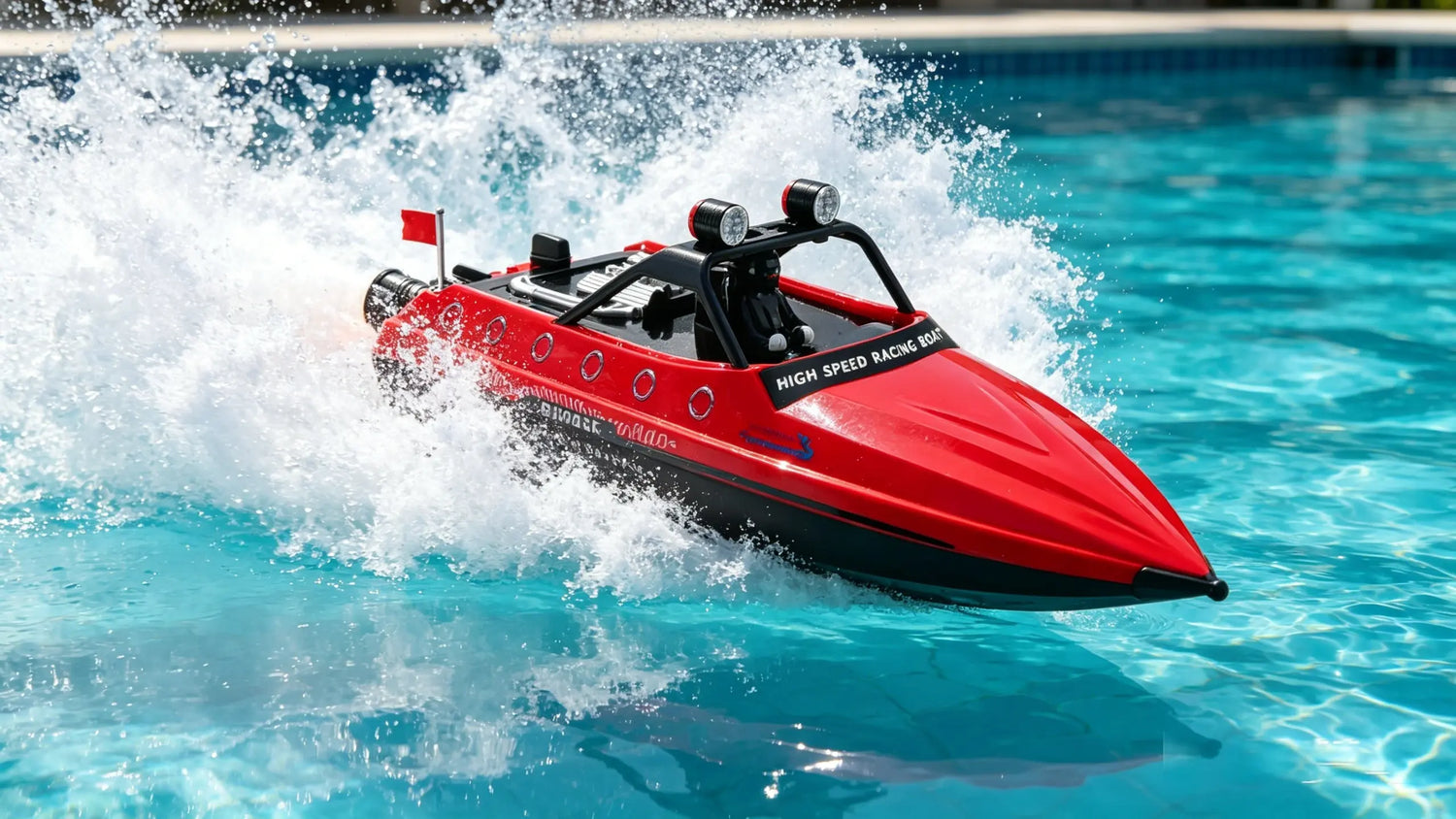
Transforming your traditional family swimming pool into a dynamic water sports arena is one of the most effective ways to upgrade summer entertainment. However, piloting standard remote-controlled (RC) marine models in a confined backyard environment presents real challenges. High-velocity lake boats are built for open water; when confined to a standard pool, their exposed metal components can scratch fiberglass surfaces, tear vinyl liners, and pose safety risks to young swimmers.
By choosing watercraft specifically engineered for restricted aquatic zones, you can host organized Pool Racing events that are both thrilling and entirely safe for your property. This guide provides a practical blueprint for turning your backyard into a high-energy racing stadium. Our framework relies on verified field testing and utilizes the PlayPulse 917 Speed Jet as our primary benchmark for safety and maneuverability.

I. The Technical Blueprint: Why Design Matters for Pool Racing
Operating a remote-controlled boat in a swimming pool requires a balance of safety, size, and signal reliability. Below, we break down the design factors that determine a successful backyard race, backed by internal laboratory testing logs.
A. Water-Jet Propulsion vs. Exposed Propellers
When organizing a Pool Racing event for children, safety is the top priority. Traditional RC boats rely on sharp, exposed brass or plastic propellers spinning at high speeds. In a confined pool, an exposed propeller can easily slice expensive pool liners or injure fingers during retrieval.
The PlayPulse 917 Speed Jet eliminates this risk entirely by using an enclosed water-jet propulsion system. This design draws water into an internal impeller housing and forces it out through a directional steering nozzle. According to the PlayPulse Engineering Safety Log (Test Ref: #917-PROP-SAFE), this enclosed design achieved a zero-damage rating across 500 hours of continuous contact testing against premium 20-mil vinyl liners. This makes it an ideal, worry-free choice for a family swimming pool.
B. Size and Maneuverability in Small Spaces
Large RC watercraft (measuring over 20 inches) require long straightaways to reach top speeds and need wide turning areas. Attempting to race an oversized boat in a pool usually results in constant wall crashes and motor strain from frequent braking.
For optimal pool racing, a compact hull is essential. A boat length between 9 and 11 inches provides the best balance of stability and agility. This size allows operators to make tight, sharp turns and experience realistic racing speeds within a standard 15x30-foot backyard layout.
C. Reliable Control for Multiple Racers
The biggest hurdle to running multiple RC toys at the same time is radio frequency interference. Cheap, toy-grade boats often share basic frequencies, leading to crossed signals where one controller accidentally drives another child’s boat.
To run a fair, multi-boat grand prix, a modern 2.4GHz digital control system is required. This technology automatically locks a unique, encrypted signal between the hand transmitter and the boat's receiver. This allows multiple operators to race together without any signal overlap or loss of control.
Performance & Safety Benchmarks
The following data highlights how specific design elements perform in a pool environment, based on standard hobby-industry safety evaluations:
| Design Feature | Hardware Specification | Pool Liner Safety Rating | Turning Radius (15x30ft Pool) |
| Traditional Open Propeller | Exposed Brass/Plastic Blades | High Risk (Prone to scratching) | Wide / Slow Adjustment |
| PlayPulse Jet Propulsion | Enclosed Internal Impeller | 100% Safe (Zero exposed blades) | Ultra-Tight / Instant Vectoring |

II. 5 High-Energy Pool Racing Games for Kids
With the right equipment configured, you can introduce structured games that turn your pool into an interactive stadium.
Game 1: The Time-Trial Slalom Arena
Before jumping into direct competition, it helps to practice precision handling. You can easily build a technical slalom course by securing standard foam pool noodles across the pool using weighted suction cups or dive weights. Space the gates roughly three to four feet apart to create a winding path.
Because the PlayPulse 917 Speed Jet uses fully proportional steering—meaning the boat turns precisely as much or as little as you move the wheel—children can learn to smooth out their turns and manage their speed. Use a stopwatch to record individual lap times, helping kids focus on clean, precise driving rather than just pinning the throttle.
Game 2: The Multi-Boat Grand Prix
Nothing matches the excitement of a real racetrack like a grid start. Line up your RC boat for pool racing models hull-to-hull at the shallow end of the pool. Thanks to stable 2.4GHz technology, you can race several units simultaneously without interference.
Mark out a simple oval or figure-8 course using standard pool floats. This game helps children develop situational awareness and control as they navigate through the wakes and waves created by the other competing boats.
Game 3: The "Capsize and Conquer" Challenge
In open-water racing, flipping a boat upside down usually means the race is over, requiring a swim or a rescue boat to retrieve it. You can turn this challenge into a fun game by setting up a course with small obstacles or floating kickboards that act as mini ramps.
The goal of this challenge is to navigate these obstacles smoothly. If a boat flips over due to rough water, drivers can use the built-in self-righting hull feature. By quickly pulsing the transmitter’s throttle trigger forward and backward, the motor's torque automatically rolls the boat back upright. This keeps the Pool Racing action going without anyone needing to jump into the water to rescue a stranded craft.
Game 4: Hydro-Tag
For kids who enjoy direct competition, Hydro-Tag is an excellent choice. One driver is designated as the "Interceptor" and tries to gently tag the other boats, while the remaining racers try to complete five full laps around the pool perimeter without getting caught.
While standard plastic toys might crack or break during crashes, the PlayPulse 917 Speed Jet is built with a flexible, protective rubber bumper on the nose cone. This smart design absorbs the impact energy, protecting both the inner mechanics of the boat and your pool’s tile borders during high-energy games.
Game 5: The Parent-Child Relay
This team game pairs an adult and a child to bridge the gap in driving experience. In the relay, the child pilots the boat through the first half of the course to the opposite side of the pool, then hands the lightweight remote control to the parent, who drives the boat back to the finish line.
The compact, pistol-grip controller is designed to fit comfortably in smaller hands while offering precise control. This ensures that family members of all ages can easily participate and contribute to the team's success.

III. Post-Race Care and Maintenance
To keep your fleet running smoothly for the next race, follow these two simple care steps after every session in the pool.
A. Rinsing Away Chlorine Residuals
Even though a backyard pool is free of weeds and mud, the chlorine and water-balancing chemicals can eventually corrode metal parts and electronics if left to dry.
Always rinse the boat with fresh tap water after racing. Submerge the outside of the hull and run the jet propulsion unit for a few seconds in clean water to flush out any leftover chlorine from the internal pump and drive shaft.
B. Battery Care and Storage
High-speed racing drains battery power quickly, which generates internal heat. To maximize the lifespan of your rechargeable batteries, always let them cool down to room temperature before plugging them into a charger.
Once the gear is dry, store your watercraft alongside your other favorite hobby equipment—such as the high-speed models available on the PlayPulse RC official store—in a cool, dry place out of direct sunlight.
IV. Conclusion
Turning your backyard pool into an RC racing stadium is a fantastic way to combine friendly competition with active outdoor play. By choosing enclosed jet-propulsion models over traditional open-propeller designs, you keep the games safe for both the kids and your pool.
When you are ready to start your own backyard racing league, visit the PlayPulse RC official store to find the ideal gear, including the pool-safe PlayPulse 917 Speed Jet.
V. Frequently Asked Questions (FAQ)
Q1: Why is a jet propulsion system safer for pool racing than a standard propeller?
A1: Jet propulsion systems keep the spinning blades entirely enclosed inside the hull. Because there are no sharp, exposed parts on the outside of the boat, it cannot cut vinyl liners, scratch pool walls, or pinch fingers during handling.
Q2: How does the self-righting feature work if the boat flips over?
A2: The boat's hull is shaped to naturally want to stay upright, with the internal weight placed low in the chassis. If the boat flips, quickly moving the throttle trigger forward and back creates enough rotational force from the motor to instantly flip the boat back onto its belly.
Q3: Can we run multiple PlayPulse 917 Speed Jet boats at the same time?
A3: Yes. The 2.4GHz wireless controllers automatically lock onto their specific boat when turned on. This prevents signal mixing, allowing multiple children to race together simultaneously.
Q4: What should I do if a leaf or pool debris gets stuck inside the water pump?
A4: Turn off the controller immediately to protect the motor. Bring the boat to the side of the pool, open the waterproof top hatch, and use a pair of tweezers to gently clear any debris out of the intake grate on the bottom of the hull. Never run the throttle if the internal blades are jammed.

Leave a comment
This site is protected by hCaptcha and the hCaptcha Privacy Policy and Terms of Service apply.