

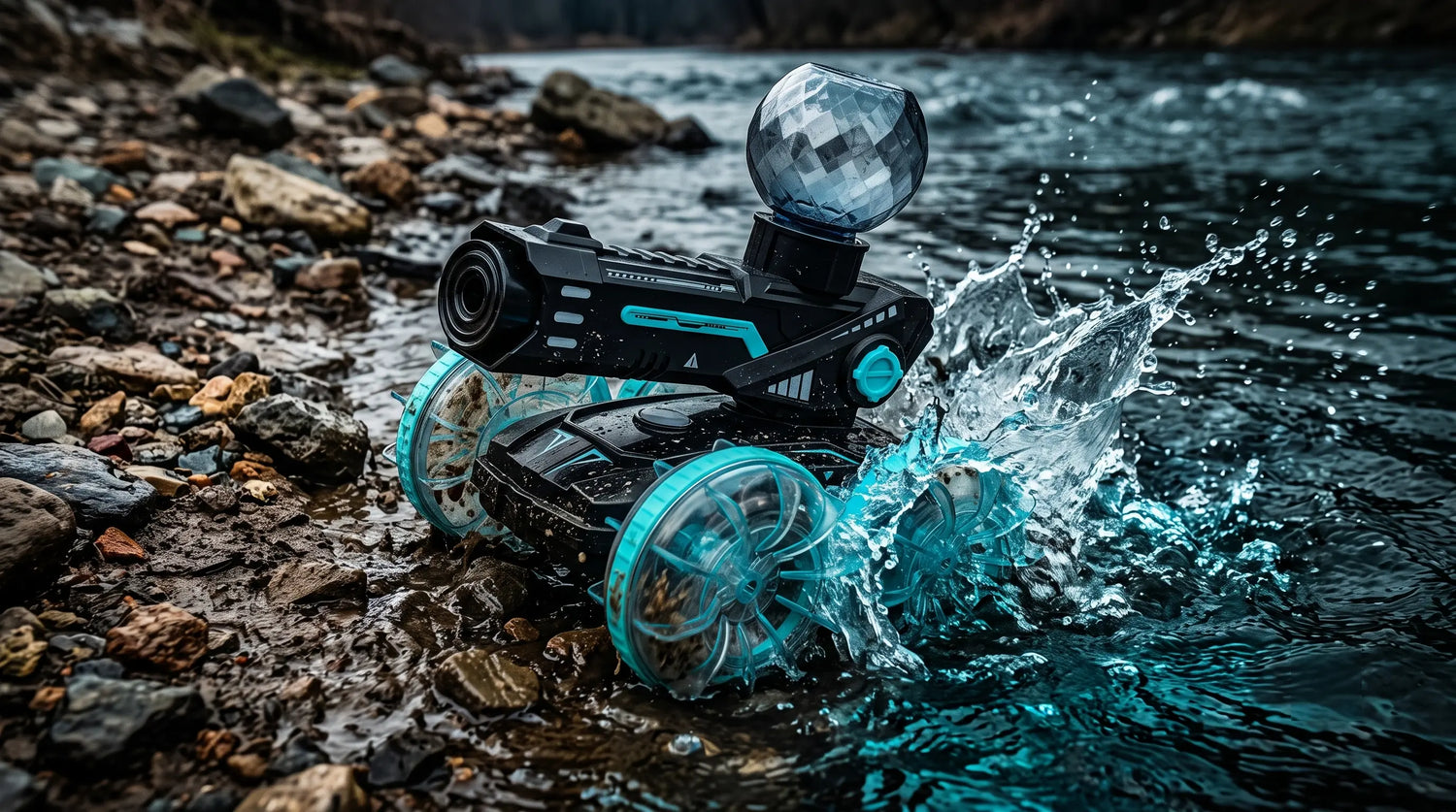
 As an RC enthusiast, you understand that the boundary between an exhilarating drive and a sudden short circuit usually lies at the water's edge. However, the engineering behind a true all-terrain amphibious RC car shatters these traditional limitations. Whether you are navigating rugged dirt trails, conquering the surface of a swimming pool, or tearing through a muddy backyard, this specialized vehicle is designed to push the boundaries of extreme driving. Welcome to PlayPulse RC, where we explore the mechanical intricacies and advanced techniques required to dominate any environment and perform flawless stunts with your amphibious machine.
The Engineering Core of an All-Terrain Amphibious RC Car
Sealed Chassis and Dual-Motor Architecture
To execute an extreme stunt over mud, snow, or water, your vehicle requires a robust mechanical foundation. The core of any high-performance amphibious RC car lies in its hermetically sealed chassis and dual-motor architecture. Unlike standard RC vehicles, the internal compartments housing the motherboard, receiver, and power supply are protected by industrial-grade waterproof silicone gaskets. This rigorous sealing process ensures structural integrity and prevents catastrophic electrical failure against water intrusion. Furthermore, the independent dual-motor setup delivers the raw torque necessary to push through high-resistance environments, giving you the immediate power output to tackle steep inclines and overcome aquatic drag simultaneously.
Propeller-Tread Wheels for Aquatic Propulsion
Traditional rubber tires fail completely when submerged, losing all traction. However, the true all-terrain capability of this vehicle is unlocked by its unique propulsion mechanism. Observing the vehicle's aggressive stance, you will notice the specialized propeller-tread wheels. These distinctive, transparent cyan wheels feature robust, diagonal thermoplastic ridges. On hard surfaces like pavement, gravel, or thick grass, these ridges act similarly to continuous tank treads, biting into the ground for maximum grip. Once your vehicle transitions into the water, these identical ridges function as hydrodynamic paddle wheels. They displace water efficiently, generating significant forward thrust and enabling rapid aquatic maneuverability without the need for a separate rudder system.

Mastering Extreme Stunts Across Diverse Environments
Executing 360-Degree Spins and Double-Sided Flips
Precision control is paramount when performing a high-speed stunt. Due to its perfectly symmetrical design and independent four-wheel-drive (4WD) system, your amphibious RC car is capable of executing flawless 360-degree tornado spins on the spot. By applying opposite directional inputs to the left and right wheel axes via the transmitter, you can induce a high-RPM cyclone effect. Furthermore, the vehicle's dual-sided chassis ensures that if you launch it over a ramp, or if it flips backward after hitting a rock outcropping, you never lose momentum. The car simply continues to drive inverted, offering a continuous, zero-interruption driving experience that redefines off-road agility.
Seamless Transitions: Pavement, Sand, and Deep Water
The true benchmark of an all-terrain vehicle is its ability to transition between drastically different surface frictions without a drop in performance. You can accelerate at full throttle on asphalt, drift through loose, shifting sand, and launch directly into a lake. The calculated buoyancy of the sealed ABS body keeps the vehicle afloat precisely at the waterline, while the paddle tires instantly take over propulsion. Mastering this transition requires precise throttle management to maintain forward momentum as the physical friction coefficient instantly changes from solid earth to fluid water.
Elevating the Stunt Experience: Tactical Water Battles
Integrating the Combat Turret System
While mastering driving mechanics is thrilling, modern engineering has evolved to offer multi-dimensional gameplay. The standout feature that separates the PlayPulse RC 1203N Amphibious RC Car from standard models is its integrated combat turret system. Mounted securely on the upper deck, the striking transparent ammunition sphere feeds a high-velocity water or gel ball cannon. This innovation transforms your vehicle from a simple driving machine into a tactical battle asset. You can strafe targets while performing a drifting stunt, or engage in full-scale aquatic warfare with other RC pilots. This strategic element vastly extends the replayability, taking your outdoor sessions far beyond simple point-A-to-point-B driving.
Performance Specifications Data Analysis
To truly understand your machine's capabilities, analyzing the telemetry and hardware specifications based on manufacturer testing is essential:
| Technical Specification | Parameter Details |
| Vehicle Class | All-Terrain Amphibious Combat RC Car |
| Drive Architecture | 4WD Dual-Motor System |
| Power Supply | 3.7V 1200mAh High-Capacity Lithium-ion |
| Operational Endurance | Up to 40-45 Minutes per charge |
| Control Telemetry | 2.4GHz Anti-Interference Remote (40-50m Range) |
| Command Interfaces | Standard Transmitter + Wearable Gesture Sensor |
| Core Capabilities | 360° Spins, Double-Sided Driving, Water Battle Mode |
Advanced Command Interfaces for Precision Driving
2.4GHz Transmitter vs. Wearable Gesture Sensing
To harness the absolute full potential of your amphibious RC car, you must master its dual command interfaces. The standard 2.4GHz transmitter offers zero-latency, anti-interference radio telemetry. This is crucial for executing precise throttle adjustments and steering inputs when navigating a technical all-terrain track alongside multiple other vehicles. However, for a deeply immersive operational experience, the wearable gesture-sensing controller translates your hand's physical tilt and spatial rotation into direct mechanical action. Lowering your wrist accelerates the vehicle forward, while a sharp twisting motion of your hand triggers an immediate 360-degree spin. This technology bridges the gap between pilot and machine, making the execution of a complex stunt feel entirely organic.
Essential Maintenance for Your Amphibious Vehicle
Operating an all-terrain machine in harsh, wet environments requires disciplined maintenance to preserve its internal mechanics. Unlike strictly indoor models or standard scale RC crawler trucks that only encounter dry dirt, your amphibious RC car regularly faces complete water submersion. After every aquatic session—especially in chlorinated pools or muddy rivers—it is imperative to flush the exterior chassis and propeller wheels with clean, fresh water. Always ensure the 3.7V 1200mAh battery is disconnected immediately after use. Thoroughly dry the battery compartment with a microfiber cloth before storage to prevent terminal oxidation and significantly extend your hardware's operational lifespan.
Integrating robust aquatic propulsion, rigorous waterproof engineering, and tactical combat turret features fundamentally redefines what a recreational vehicle can achieve. By mastering its dual-motor architecture and advanced gesture command interfaces, you are no longer limited by the terrain in front of you. Push the technical limits of your all-terrain amphibious RC car, experiment with aggressive driving in new environments, and elevate your off-road stunt experience to unprecedented heights.

Frequently Asked Questions (FAQ)
Q1: What is the maximum control range for an amphibious RC car on water? When operating your amphibious RC car via the 2.4GHz transmitter, you can expect a reliable, anti-interference control range of approximately 40 to 50 meters (130 to 160 feet). This provides ample distance for commanding the vehicle across large swimming pools or safely exploring the edges of a lake while maintaining immediate telemetry response.
Q2: Can this all-terrain RC car drive on thick grass? Yes. The combination of the dual-motor 4WD system and the aggressive, diagonal ridges on the propeller-tread wheels allows the vehicle to grip and pull itself over thick grass and uneven terrain. However, navigating high-resistance surfaces will draw more current from the motors, slightly reducing the overall battery runtime compared to driving on smooth pavement.
Q3: How long does the 3.7V 1200mAh battery last during extreme stunts? The upgraded 3.7V 1200mAh lithium-ion battery is engineered for extended endurance. Under mixed driving conditions—combining flat land acceleration, water navigation, and occasional stunts—a fully charged battery delivers up to 40 to 45 minutes of continuous play.
Q4: Are the water-firing mechanics safe for indoor play? The combat turret is designed to fire soft, water-based gel beads or streams of water, which are physically harmless upon impact. However, due to the rapid-fire nature of the turret and potential water dispersion, it is highly recommended to reserve the combat features for outdoor environments to prevent slippery floors.

Leave a comment
This site is protected by hCaptcha and the hCaptcha Privacy Policy and Terms of Service apply.