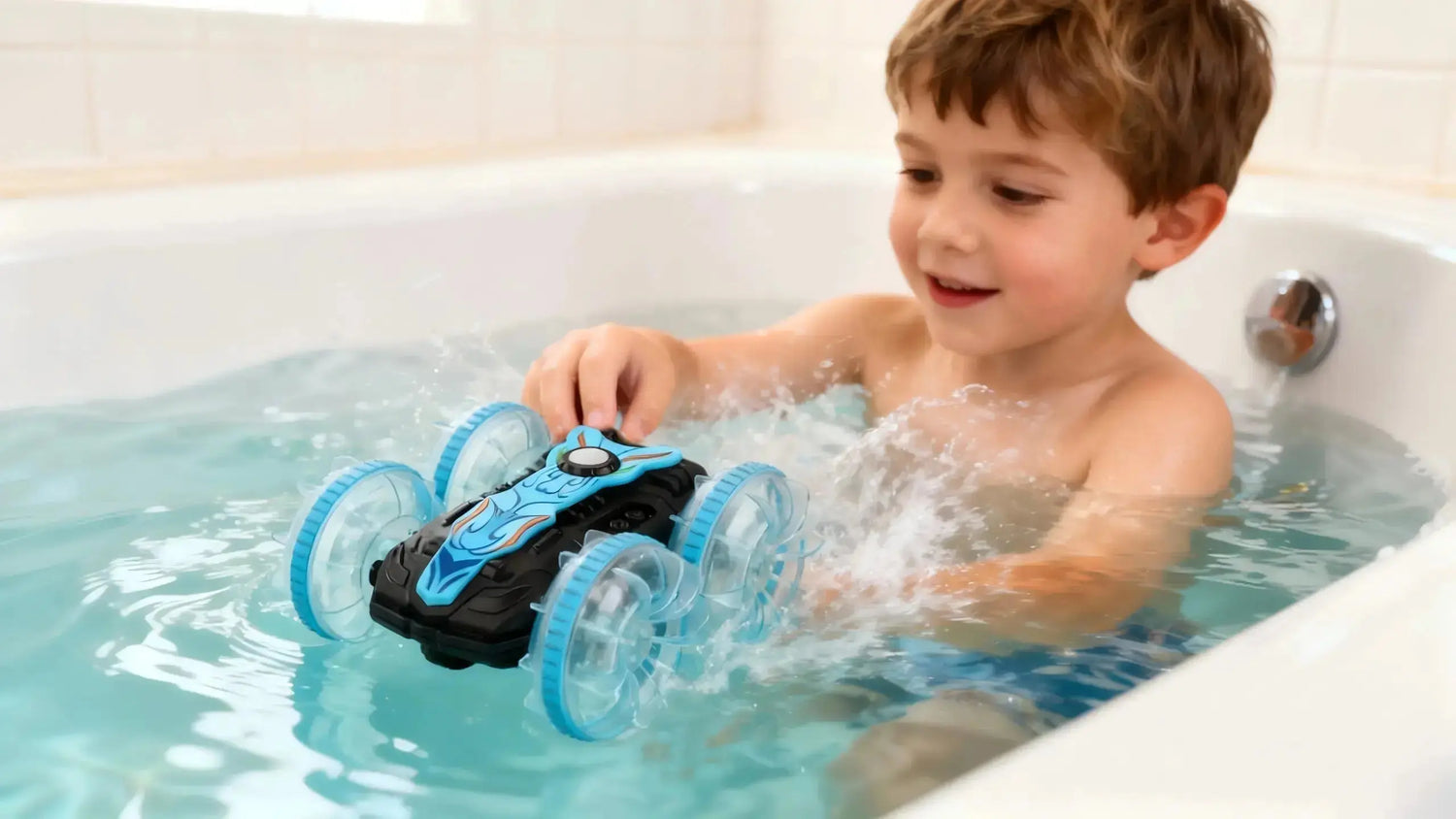
RC boats can look like perfect rainy‑day fun, but bathrooms add real risks. This parent‑first how‑to explains RC boat bathtub safety in plain terms: when to skip it, how to minimize risk if you still proceed, and age‑fit buying criteria under $50. Throughout, we anchor guidance to pediatric water‑safety norms and toy standards so you can make a clear, confident decision.
Key takeaways
-
Young children can drown in very shallow water; bath play demands arm’s‑reach, eyes‑on adult supervision at all times.
-
Keep electricity out of bathrooms: no chargers, cords, or mains‑powered devices near the tub; GFCI outlets should be present and tested.
-
If you proceed, choose tiny, sealed, low‑power micro boats with shrouded props, use shallow water, and keep sessions brief.
-
Prefer sink/bin regattas or non‑electronic bath toys for younger kids; they deliver the fun with fewer hazards.
-
Age‑fit criteria matter more than speed or features; many hobby‑grade boats aren’t evaluated as bath toys.

Quick verdict — RC boat bathtub safety in one look
Short answer: it’s possible but not broadly recommended. Bathtubs combine water, slippery surfaces, and sometimes nearby electricity—risk factors for kids and electronics. If your goal is safe indoor water play, a “sink or bin” setup on a dry, stable counter is usually the better choice.
Only proceed in a bathtub if all of the following are true:
-
An adult remains within arm’s reach for the entire session and never looks away.
-
Water is kept shallow; remove toys if toddlers arrive or younger siblings join.
-
No cords, chargers, or plug‑in devices are present in the bathroom; GFCI protection is available.
-
The boat is tiny, well‑sealed, and low‑power with a covered/shrouded prop and water‑activation.
-
You can stop immediately if the boat flips, leaks, or a battery shows any issue.
Avoid bathtub RC entirely if any of the following apply:
-
Infants/toddlers use the bathtub; supervision cannot be continuous and at arm’s reach.
-
The boat has exposed, fast‑spinning props or high speed; seals are questionable.
-
The bathroom outlets are not GFCI‑protected or there are nearby plug‑in devices.
-
You plan to charge batteries in the bathroom or store spares there.
According to the American Academy of Pediatrics, young children can drown in as little as 1–2 inches of water, and bath‑time requires constant “touch supervision.” See the AAP’s parent guidance in Water Safety & Young Children and Safety for Your Child: 1 to 2 Years.

How to minimize risk if you still proceed (harm‑reduction)
Step 1 — Pre‑use safety checks
Set the bathroom up like a controlled play space. Place a non‑slip mat outside the tub, remove any plug‑in devices and chargers from the room, and confirm your outlets are GFCI‑protected. Prepare towels and dry clothes before you start. Verify the boat’s hatch seal, battery compartment, and any propshaft or linkage pass‑throughs are closed and dry. Pair the remote and do a quick range check from arm’s reach.
The CDC emphasizes that drowning is fast and quiet; infants’ most common in‑home drownings occur in bathtubs. Review the CDC’s guidance in Preventing Drowning and VitalSigns — Drowning.
Step 2 — Safe operation rules
Keep water shallow and hair, clothing strings, and jewelry away from the propeller. Choose micro boats with shrouded props and water‑activation (motors run only in water). Power off before touching or lifting the boat. Stay at arm’s reach, keep sessions brief (10–20 minutes for younger kids, a bit longer for older children), and stop immediately if you notice leaks or unusual behavior.
Step 3 — Recovering a flipped boat
If the boat flips or stalls, turn off power first to avoid prop injuries and electrical stress. Lift the boat carefully, drain water from the hull, and inspect seals and linkages. If water entered the hull, do not resume play; proceed to drying.
Step 4 — Post‑play drying & storage
Power off and remove the battery away from the bathroom. Blot moisture, air‑dry thoroughly, and use desiccants if needed. Inspect for corrosion the next day before re‑use. Store and charge batteries outside bathrooms. Hobby best practices recommend checking hatch tape and applying a small amount of marine grease to the propshaft to reduce leaks; for a general troubleshooting primer, see Bezgar’s RC boat issue guide.

Waterproofing and IP ratings, simplified
“Waterproof” is often used loosely in marketing. IP (Ingress Protection) codes provide clearer expectations. Immersion‑rated products (IPX7/IPX8) tolerate water under defined test conditions, but real‑world boats may still leak through hatches or shafts if not sealed.
According to Siemens’ IEC 60529 summary, these are common water ratings:
|
IP Code |
What it means for water exposure |
|---|---|
|
IPX4 |
Resistant to splashes from any direction (not immersion). |
|
IPX6 |
Resistant to powerful water jets (not immersion). |
|
IPX7 |
Tolerates immersion up to ~1 m for ~30 minutes under test conditions. |
|
IPX8 |
Suitable for continuous immersion under manufacturer‑specified conditions. |
If you’re comparing general waterproofing expectations for RC boats, see the context notes on our collection page: PlayPulse RC remote control boats.

Battery basics parents should know (AA/NiMH vs Li‑ion/LiPo)
Battery chemistry affects indoor safety near water. NiMH AA/AAA setups generally have lower energy density and a lower thermal‑runaway risk than lithium‑ion/LiPo packs; failures tend to be leakage or venting rather than fire. Lithium‑ion/LiPo requires correct chargers and careful handling; if a pack shows swelling, corrosion, or signs of water intrusion, stop using it.
For accessible technical context, Battery University explains lithium‑ion safety concerns and packaging norms in Lithium‑ion safety concerns and battery packaging basics. CPSC recalls also show how water intrusion can trigger short circuits and fires in underwater devices; see Ocean Technology Systems recall (2022).
Age‑fit buying criteria (+ under‑$50 mini‑model features)
Parents often ask what features matter most. Think of it this way: pick for safety and skill development, not for speed.
-
Ages 3–5: Choose non‑electronic bath toys. Avoid RC with exposed propellers or any powered devices in bathtubs with toddlers.
-
Ages 6–8: If attempting RC play under arm’s‑reach supervision, pick micro boats with water‑activation, modest speed, sealed hulls, and shrouded props; keep sessions short.
-
Ages 9–12: Slightly larger mini boats can be fun in basins/sinks or kiddie pools with close supervision; avoid high‑speed models in bathtubs.
Typical under‑$50 micro‑boat features marketed for tubs/pools include propeller covers, water‑activation, 2.4 GHz radios, and runtimes around 15–20 minutes with 60–90 minute charge times.
Disclosure: PlayPulse RC is our product. If you’re browsing for kid‑suitable, low‑power boats, look for sealed battery compartments, shrouded props, and clear age 6+ labeling; remember this guide does not endorse bathtub use for most families.
For general toy selection and age‑appropriateness, the CPSC’s guide Which Toy for Which Child (PDF) explains how to match toys to abilities and development.

Safer indoor alternatives kids still love
A sink or bin regatta shifts the fun away from the bathroom while keeping controls simple. Place a large dishpan or sink on a dry, stable counter, keep the water shallow, and supervise at arm’s reach. After play, empty and dry promptly.
Non‑electronic bath toys—like wind‑up or magnetic boats—deliver steering practice with far fewer hazards. For families in small spaces, a plastic storage bin on a table with towels underneath and a non‑slip mat nearby keeps footing secure and electronics out of the bathroom altogether.
Safe Kids Worldwide recommends preparing bath supplies in advance, keeping infants and toddlers within arm’s reach, and emptying tubs immediately after use. See their parent guide A Parent’s Guide to Child Safety.
Frequently asked safety questions
-
Are RC boats “waterproof” enough for baths? Some are splash‑resistant; true immersion tolerance is indicated by IPX7/IPX8, yet boats still have real‑world leak paths (hatches, shafts). Parents should treat “waterproof” as relative and inspect seals before use.
-
Can I charge the boat’s battery in the bathroom? No. Keep chargers and spares outside bathrooms; outlets should be GFCI‑protected. The NFPA advises GFCI protection and keeping electrical devices away from tubs; see NFPA’s GFCI tips.
-
What if electronics get wet? Power off, remove battery outside the bathroom, blot and air‑dry thoroughly, and use desiccants. Inspect for corrosion before the next session. If a lithium‑ion battery shows swelling or damage, discontinue use.
-
Is bathtub RC appropriate for toddlers? No. The AAP cautions that very shallow water can be deadly and requires constant touch supervision; non‑powered toys are a better choice.
Sources & further reading
-
AAP — Water Safety & Young Children; Safety for Your Child: 1 to 2 Years
-
CDC — Preventing Drowning
-
NFPA — Home GFCI safety tips
-
IEC 60529 — summarized meanings via Siemens technical planning information