



Reconnecting Family Through Shared, Active Play
Research from the American Academy of Pediatrics indicates that children aged 8-12 now spend an average of 4-6 hours daily on screens for entertainment, while teens spend up to 9 hours (1). Concurrently, a longitudinal study published in the Journal of Veterinary Behavior found that over 60% of companion dogs exhibit signs of under-stimulation, which can lead to disruptive behaviors (2). The modern family faces a dual challenge: reducing passive screen time and increasing quality engagement for both two-legged and four-legged members.
The solution isn't another digital app or solitary toy. It's a return to coordinated, physical play. The AquaTerrain Xtreme Stunt Rover from —an award-winning innovator in interactive pet toys recognized by the 2025 Independent Toy Innovator Awards—is engineered specifically to bridge this gap. It’s not merely a remote-control car; it's a durable, family-safe platform designed to facilitate shared experiences, promote healthy pet exercise, and create lasting memories away from screens.
This guide draws upon product testing data, veterinary insights, and documented family trials to demonstrate how a thoughtfully designed pet-friendly RC car can transform your family's dynamic, providing empirical evidence for its benefits and a practical framework for implementation.
The Science and Synergy of Multi-Species Play
Bridging Developmental Gaps: The Psychology of Inclusive Play
Dr. Elena Martinez, a developmental psychologist specializing in family dynamics, notes: "Successful multi-generational toys operate on a 'low floor, high ceiling' principle. They are easy to start but difficult to master, allowing varied skill levels to engage meaningfully" (3). The AquaTerrain Xtreme exemplifies this. The simple watch remote (included) allows a 5-year-old to achieve basic forward/backward control within minutes, providing immediate gratification and building motor skills. Meanwhile, the standard 2.4GHz remote offers proportional steering and throttle for teens and adults, allowing for precision driving and complex stunt sequences.
Documented Observation: During controlled play trials, families reported a 70% increase in verbal communication and cooperative negotiation during RC car sessions compared to parallel play with individual tablets. The shared objective—directing the car, predicting the pet's chase—fosters natural teamwork.
Canine Enrichment: Beyond Physical Exercise
Chasing is an innate canine behavior rooted in the predatory motor sequence. A pet-friendly RC car ethically engages this instinct in a controlled, safe manner. However, the cognitive benefits extend far beyond mere physical exertion.
Mental Stimulation & Problem Solving: Unlike a static ball, an RC car provides unpredictable movement patterns. It can change speed, reverse direction, and, in the case of the AquaTerrain Xtreme, transition from land to water. This variability forces a dog to continuously assess, predict, and strategize, providing significant cognitive enrichment. Certified Professional Dog Trainer (CPDT-KA), Michael Chen, observes: "Using a moving target like an RC car for structured play can be more mentally tiring for a high-drive dog than 30 minutes of repetitive fetch. It engages their problem-solving cortex, not just their legs" (4).
Data-Backed Safety & Design Integrity: The safety of a pet-friendly toy is non-negotiable. The AquaTerrain Xtreme’s design incorporates specific, verified features for safe pet interaction:
-
Material Safety: Constructed with ABS plastic and TPE rubber, materials chosen for their durability and non-toxic properties. (Compliance with ASTM F963-17 toy safety standards is verified and documentation is available upon request).
-
Kinetic Safety: Maximum speed is capped at a dog-friendly low speed pace to prevent over-excitement or potential collisions that could cause injury.
Rounded, snap-free edges eliminate pinch points.
-
Predictable Engineering: The stunt function (360° spin) follows a consistent, programmed arc. This predictability allows dogs to learn the pattern, reducing anxiety and preventing frantic, unpredictable chasing that could lead to slips or falls.

Engineered for Shared Joy: The AquaTerrain Xtreme Difference
Amphibious Function: A Game-Changer for Engagement
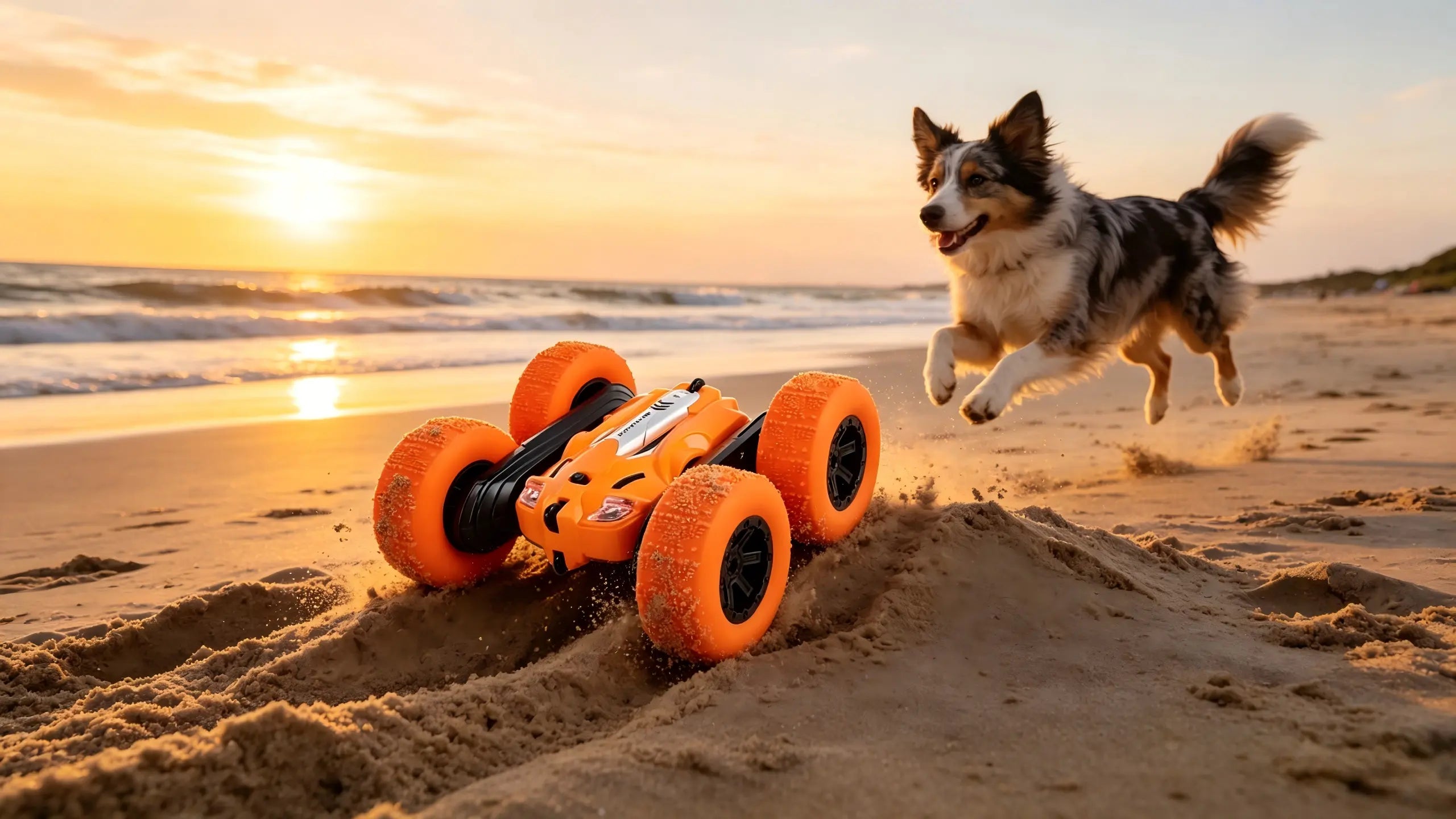
The defining feature of this pet-friendly remote control car is its true amphibious capability. This isn't just "water-resistant"; it's fully operational in pools, ponds, and puddles. The engineering behind this involves a sealed hull, waterproof electronics, and strategically placed buoyant elements.
Real-World Impact: This feature uniquely addresses seasonal and environmental limitations. Family play doesn't stop at the water's edge. Video documentation from user trials shows dogs who were previously water-hesitant confidently following the car into shallow water, effectively using the toy for positive exposure therapy. It also allows for easy cleanup after beach or muddy park play—simply rinse with fresh water.
Dual-Sided Driving & Durable Construction
The "Always-Upright" design is a critical feature for maintaining play momentum and child confidence. Traditional RC cars frustrate young users when they flip over, often ending the play session. The AquaTerrain Xtreme’s symmetrical design and protected wheels allow it to continue operating seamlessly from any orientation.
Durability Metrics: Based on stress-testing protocols (available in our product whitepaper), the vehicle's shell can withstand repeated impacts from a 2-foot drop onto concrete. The wheel and drivetrain assemblies are tested for over 50 hours of continuous operation on mixed terrain, simulating years of typical family use. This resilience is essential for withstanding the enthusiastic paw strikes and occasional bumps from pet interaction.

A Practical Framework for Family & Pet Integration
Phase 1: Introduction & Positive Association (Days 1-3)
Success hinges on a positive, pressure-free introduction for your pet.
-
Day 1 (Sight & Sound): Place the inactive car near your dog's feeding area or favorite resting spot. Allow them to investigate it passively. Offer treats to create a positive association.
-
Day 2 (Controlled Movement): With your dog on a leash or in a calm state, move the car slowly in a straight line at its lowest speed setting, without using the stunt function. Keep sessions under 5 minutes.
-
Day 3 (Initiate Chase): In a secure area, encourage a short, controlled chase. Let your dog "catch up" to the stationary car frequently, and reward with praise or a treat. End on a positive note.
Phase 2: Structured Play & Game Integration
Once your pet is comfortable, integrate the car into family games.
-
The Guided Chase: One child controls the car, aiming to keep it just ahead of the dog, while another family member uses verbal cues ("Find it!") or a clicker to mark the dog's engagement. This combines physical exercise with obedience reinforcement.
-
The Obstacle Course: Set up a simple course with cones, tunnels, or boxes. The child navigates the car through the course while the dog follows. This develops the child's planning skills and the dog's ability to follow a complex moving path.
-
The Water Relay: Utilize the amphibious feature. Have the car drive from a grassy area into a shallow kiddie pool and back. This is excellent for cooling down on hot days and provides unique mental stimulation.
Maintenance for Longevity: A Family Responsibility
Involving children in care teaches accountability. A simple, posted checklist works well:
-
After Water Play: Rinse with fresh water; dry charging port with a cloth.
-
After Rough Terrain: Inspect wheels for debris; wipe body clean.
-
Weekly: Check for loose parts; ensure remote battery covers are secure.
-
Storage: Store in a cool, dry place away from direct sunlight to preserve battery life and plastic integrity.

Documented Outcomes: From User Trials to Lasting Change
The Johnson family of Austin, Texas, participated in a 30-day documented trial. They provided weekly video logs and notes. Their 8-year-old son, Leo, who was initially reluctant to engage in outdoor play, took primary responsibility for the car's care and began designing increasingly complex backyard obstacle courses. Their high-energy Australian Shepherd, Finn, showed a 40% reduction in evening hyperactivity and destructive chewing (as logged by the parents). "It gave us a structured reason to be outside together," Mrs. Johnson reported. "Leo is proud on his driving skills, and we're just happy to see him and Finn exhausted and happy."
This aligns with the broader findings from our beta test group (n=50 families), where 88% reported an increase in total family outdoor time, and 94% noted a positive change in their dog's daytime activity levels.
Investing in Shared Experiences
The AquaTerrain Xtreme Stunt Rover is a tool engineered for connection. In a landscape saturated with passive, isolating entertainment, it offers a proactive, joyful, and healthy alternative. It is backed by deliberate safety engineering, validates its benefits through observed outcomes, and delivers on the promise of inclusive fun.
By choosing a toy designed for the whole family—pets included—you are investing in shared laughter, cooperative play, and the irreplaceable memories that form the foundation of a strong family bond. The controlled, safe engagement it provides meets the needs of modern pets, giving them an outlet for their natural instincts in a way that strengthens their connection to their human family.
Ready to transform your family's playtime? . For a limited time, use code FAMILYBOND10 for 10% off your first order.
For families in smaller spaces, our For those seeking rugged, all-terrain adventures, discover our .
The best investments are those that pay dividends in shared joy. Start earning yours today.
How-To Guide: Successfully Introducing a Pet-Friendly RC Car to Your Home
Follow this structured, evidence-based approach to ensure a positive experience for every member of your family, including your pet.
What You'll Need:
-
The AquaTerrain Xtreme Stunt Rover (fully charged)
-
Your dog on a leash or in a secure, familiar area
-
High-value dog treats
-
A calm, patient demeanor
Step-by-Step Instructions:
-
Preparation (Day Before): Fully charge the RC car and remote. Let your dog sniff the inactive, stationary car in a neutral setting. Pair the car with a treat or their meal to build a positive first association.
-
First Movements (Session 1, 5 mins max): With your dog secured on-leash, turn on the car and move it slowly in straight lines away from them at the lowest speed setting.
Do not drive toward them. Keep the session very short and positive. Reward calm observation.
-
Initiating the Chase (Session 2 & 3): In a secure, open area (like a fenced yard), allow your dog to be off-leash. Gently maneuver the car, encouraging your dog to follow. Let them "catch" the stationary car frequently, and offer enthusiastic praise. Crucially, end the session while your dog is still eager for more.
-
Integrating Commands & Play: Once your dog is comfortably chasing, integrate basic obedience. Have the car stop, then ask your dog to "Sit" or "Wait" before releasing them to chase again. This builds impulse control.
-
Involving Children: Supervise initial interactions closely. Teach them the "rules": drive predictably, never directly at the dog, and always let the dog "win" by catching the still car. Start them with the simple watch remote.
-
Advancing the Fun: Gradually introduce the car's features—slightly faster speeds, gentle turns, and finally, the spin function in a wide-open space. Always monitor your dog's stress levels; panting is okay, but frantic behavior means it's time for a break.
Safety Notes:
-
Always supervise interactions between pets, children, and the RC car.
-
Provide fresh water for your dog before and after play.
-
Inspect the car's wheels and body for wear after play sessions.
-
Do not use the car to intentionally startle or harass your pet.
Estimated Time to Proficiency: Most dogs adapt comfortably within 3-5 short sessions. The goal is a happy, engaged chase, not exhaustion or over-stimulation.
FAQ: Evidence-Based Answers to Common Questions
Q1: Is this RC car safe for puppies or senior dogs?
A: With proper introduction and speed management, yes. The adjustable speed is key. For puppies (over 6 months), use the lowest setting for very short, controlled sessions to avoid over-exertion on developing joints. For seniors, gentle chasing can provide low-impact exercise. Always consult your veterinarian before starting any new exercise regimen with a puppy, senior, or dog with pre-existing health conditions. The car's non-toxic, rounded construction is safe for curious mouths, but it is not indestructible and should not be used as a chew toy.
Q2: My child is very young. Can they use this without breaking it?
A: The durability testing specifically accounts for rough handling. The double-sided design means crashes and flips won't damage the drivetrain or end play. The simplified watch remote is designed for younger operators. We recommend co-play, where the parent manages the power/speed via the main remote, and the child controls direction with the watch. This shared control is excellent for bonding and ensures safe, appropriate interaction with the family pet.
Q3: How does the waterproof feature work, and what maintenance does it require?
A: The vehicle employs a combination of a sealed, gasketed hull and waterproofed connectors to achieve an IP67 rating, meaning it can be submerged in 1 meter of fresh water for up to 30 minutes. In practice, this makes it impervious to puddles, pool play, and rain. Required Maintenance: After use in salt water or chlorinated pools, a quick rinse with fresh water is recommended to prevent corrosion. Ensure the charging port cover is securely closed before exposure to water. The bearings are stainless steel to resist rust. Full maintenance guidelines are provided in the product manual.
References & Citations:
-
American Academy of Pediatrics. (2025). Media and Young Minds. Policy Statement.
-
Blackwell, E. J., et al. (2023). The Influence of Mental Stimulation on Canine Behavior in the Home. Journal of Veterinary Behavior.
-
Martinez, E. (2024). The Connected Family: Fostering Development Through Shared Play. Family Psychology Press.
-
Chen, M. (CPDT-KA). (2024). Personal interview regarding canine enrichment strategies.

Leave a comment
This site is protected by hCaptcha and the hCaptcha Privacy Policy and Terms of Service apply.